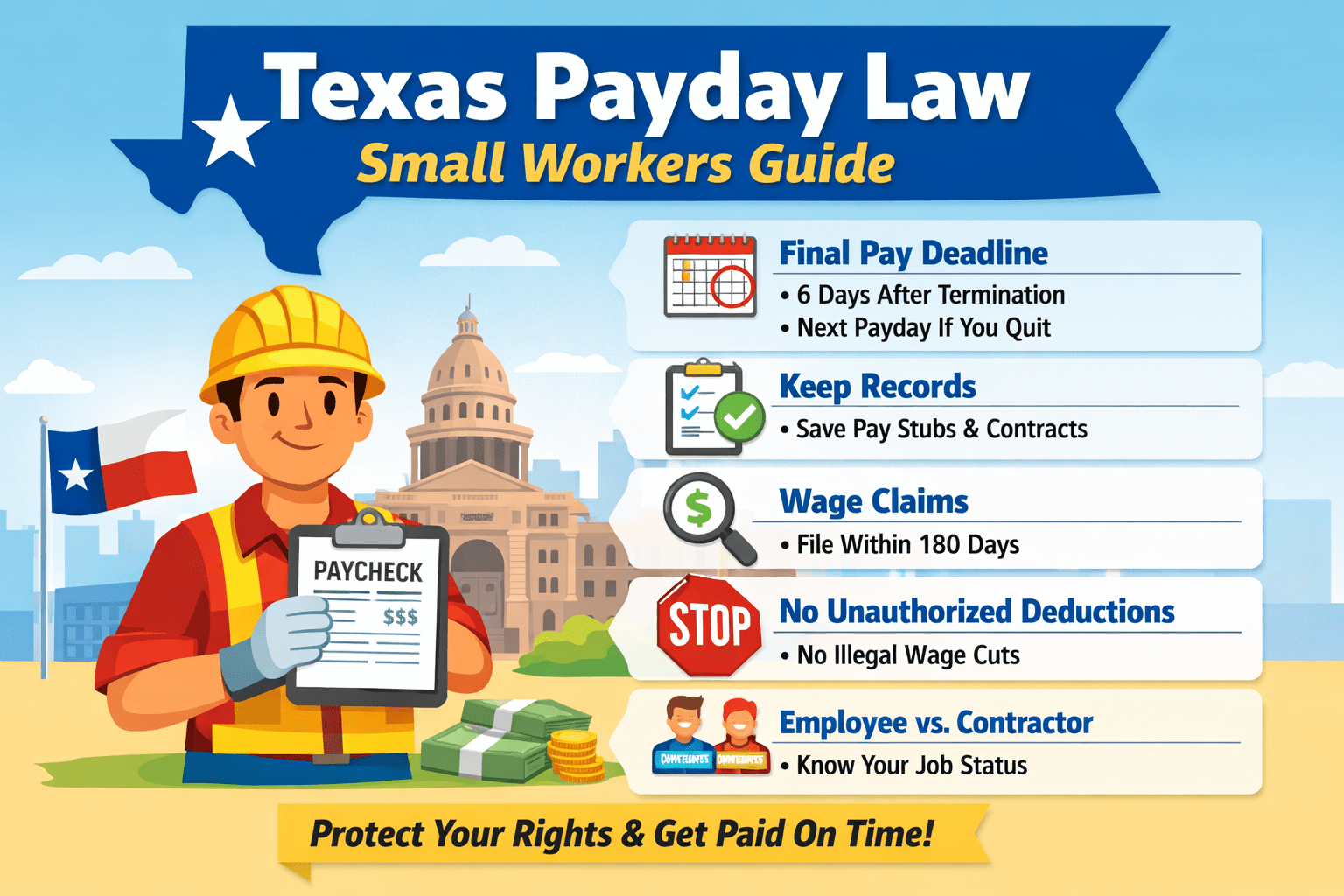
Texas Payday Law entitled to be paid for their work in a timely manner after they are fired, laid off or quit the job. … It details deadlines for final paychecks, rules on when and how workers must be paid and what’s considered an illegal or legal deduction. The law serves as a guide for employees on how to file a wage claim process, including information about employee rights and who to reach out to when payments are late or missing. Knowing these rules can empower you to liberate your situation from financial posturing — and tell what you should do if your employer breaks the law.
Five Legal Issues To Watch Out For
- Know the deadline: If you were terminated, what you’re owed is your last paycheck due to you six days after termination; if you quit, it’s on your next scheduled payday.
- In case of issue over pay keep your evidence in the form of written produce: pay slips, contracts and messages.
- Watch for deductions: Unless you give consent in writing, or unless there’s a legal reason for it, an employer typically cannot deduct money from your paycheck.
- Do It In 180 Days: Time to file or lose right to recover wages.
- Verify your employment status: You need to be an employee, not an independent contractor, to qualify for the full protections.
Table of Contents
What is the law about salary pay in Texas?
Employers in Texas have to pay employees according to clear rules. The law requires that workers be paid for everything they do, regardless of whether they are paid by the hour or salary or commission.
The rule itself is found in the Texas Labor Code 61.014, which gives details on when final paychecks are to be given. Employers must:
Pay workers according to the pay schedule
Listing out all earned wages, including bonuses (if applicable)
Avoid illegal deductions from wages
Keep proper payment records
This law covers most private employees, but it does not always apply to independent contractors.
Texas Paydays and When an Employer Must Provide Payment
The timing depends on how your job concludes:
- If you have been fired or laid off: You must get paid within 6 days
- If you leave your job: You’re entitled to payment on the next regular payday
This rule guarantees workers aren’t stuck waiting for their money. The violation could well be the delayed receipt of wages on your employer’s part.
Is it good pay to make $20 an hour in Texas?
The “good-ness” of $20/hour depends on your location and lifestyle. In many parts of Texas:
It is considered above the minimum wage After rearranging
It can cover modest living expenses in smaller cities
It might be snug in big metropolitan areas, including Houston or Dallas
However, relative to other states, Texas still has a lower cost of living and so $20/hour can be an appropriate wage for many workers.
Is Texas payroll monthly OK?
Yes, but only for some workers.
Non-exempt employees (hourly workers): At least twice monthly
Exempt employees (salaried workers): May be paid Monthly
For hourly positions the former guarantees income; for salaries the latter offers power.
Where to find the PDF of the Texas Payday Law?
The official Texas Payday Law PDF can be found here on the Texas Workforce Commission site. This document explains:
- Wage payment rules
- Filing claims
- Employer responsibilities
- Employee rights
Once you have read through the official PDF, it is much clearer where your legal position lies.
April 6, 2020 What is Texas Payday Law final pay?
Final pay is the last paycheck received upon leaving a job.
It includes:
- Unpaid wages
- Earned bonuses (if agreed)
- Commission payments
- Approved benefits
Employers must follow strict deadlines. If they don’t, you can file a claim under Texas Labor Code 61.051 to collect wages that were never paid.
What Is a Violation of the Texas Payday Law?
When an employer is in violation of wage laws, that’s a violation. Common examples include:
- Not paying on time
- Withholding wages without permission
- Making illegal deductions
- Refusing to give final pay
If that happens, you can then file a complaint with the Texas Workforce Commission.
What is the statute of Texas Payday Law?
The statute is a body of Texas Labor Code law. These laws define:
- Who qualifies as an employee
- When wages must be paid
- What deductions are allowed
- How disputes are handled
These rules help define expectations for employees and, therefore, employers.
Does the Payday law apply to cell phone corporate deductions?
Employers cannot deduct money for phones or similar items, unless:
- You gave written permission, or
- It is required by law
That being said, provided contracts were in place and parameters of them had been established clearly, a company could issue you references for damage to work cell phones but not enough to have payment deducted from your pay statements. It also allows workers to protect their rights against cuts in compensation.
Texas Payday Law Poster
Texas Payday Law poster: employers should post this in the worksite This poster enumerates employees’ rights, which include:
- Pay schedules
- Filing complaints
- Wage protection rules
If your workplace does not have one, it is likely out of compliance.
What are Texas Payday Law deductions rules?
The only circumstances in which a employer may deduct wages include:
- Required by law (like taxes)
- Court-ordered (like child support)
- Written authorization by the employee
Unauthorized deductions are illegal. An owner cannot cut wages of its employees at random because a creditor vs debtor dispute exists.
Most employers cannot go without paying you for 5 years.
An employer cannot put off paying legally past:
- The 5th Business Day after Employment End Date (if terminated)
- Next payday (if you quit)
- If after such time payment is not received, you can file a wage claim. Delaying too long can damage your case, so move fast.
What is a wage claim?
A wage claim is made when an employer owes back wages to their employee and fails to pay it.
A wage claim is an official complaint you make when your employer fails to pay you correctly.
You can file it:
- Online
- By mail
- In person
- Important points:
- You must file within 180 days
- Show evidence such as pay stubs/ contracts
- Your claim will be investigated by the state
This process allows workers to recover unpaid wages without a court date.
Does Texas payday law apply to independent contractors?
No, independent contractors are not included.
Instead, they rely on:
- Their contract agreement
- Civil lawsuits if unpaid
- If a contractor is not paid, they can sue for breach of contract. There can an issue with misclassification, like we saw in some of the Texas harassment case, where worker rights are contested.
What To Do When You Cannot Return Company Property After Separation
Employers should not automatically deduct for property that is not returned:
- You agreed in writing
- A court ordered it
- Otherwise, they must petition the court to get their property back.
Why understanding wage laws matters
Knowing your rights helps you:
- Avoid being underpaid
- Take action quickly
- Protect your financial stability
Things such as income laws assisting to help you choose much better company decisions, giving information that goes toe to toe right with the level of North Carolina Divorce Rate & Statistics.
FAQs
What is the texas payday law?
The Texas Payday Law is a bunch of rules that says when employees need to be paid. It addresses wage payments, deductions and final paycheck timelines.
Is the texas payday law applicable to independent contractors?
Are independent contractors covered? They are dependent on their contract terms and can take legal action if they are not paid.
Legal Summary & Guidance
Texas law ensures timely payment of wages — and protects against improper deductions. In either instance, the law has detailed what and when you should be paid — and next steps to take if your employer doesn’t follow the rules. The best way to secure your income and avoid legal problems is by knowing your rights, submitting claims in a timely manner and keeping records.