

Divorce becomes more complicated when one spouse believes cheating has occurred. Knowing how to prove adultery in divorce cases can make a big difference in custody decisions, property division, and even alimony outcomes in some situations. However, courts usually require clear and convincing evidence, not just suspicion or rumors.
In this guide, you will learn what counts as valid proof, how adultery evidence, private investigator reports, phone and message records, and witness statements may be used, and how divorce laws handle marital misconduct, cheating claims, and infidelity disputes. Our goal is to help spouses understand their legal options in a simple, practical way while protecting their rights and emotional well-being during the divorce process.
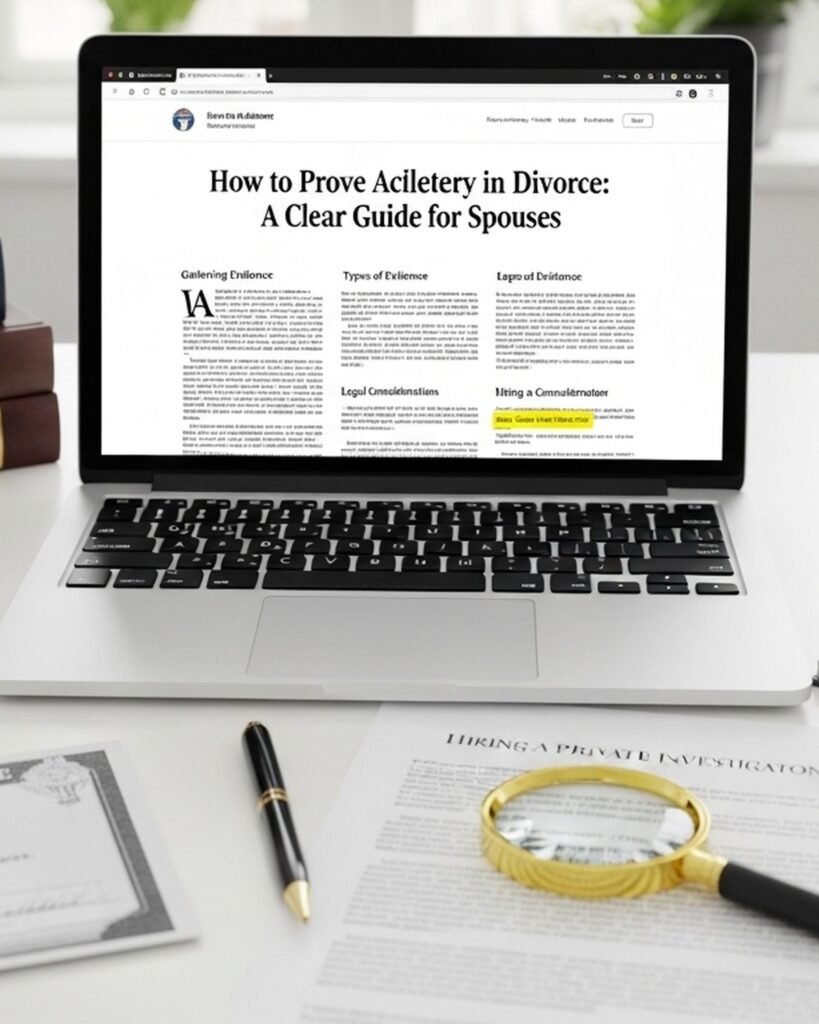
Table of Contents
Legal Definition of Adultery in Divorce Cases
In divorce cases, the spouse accusing the other of adultery must prove the claim with solid evidence, not just suspicion or rumors. Courts usually require proof showing that the affair more likely than not happened, and some states demand even stronger evidence.
This means personal doubts or gossip are not enough. The accusing spouse typically needs clear support such as messages, financial records, witness testimony, or investigator reports.
Because meeting this legal standard can be difficult and costly, many couples choose settlement or no-fault divorce instead of fighting over adultery in court.
States That Recognise Adultery as Grounds for Divorce
Although every state offers no-fault divorce, many still allow fault-based grounds, including adultery, to influence divorce proceedings. Examples include Virginia, South Carolina, New Jersey, New York, Texas, and others.
For instance, South Carolina law expressly states that “no divorce shall be granted except upon one or more grounds, including adultery. Likewise, Virginia’s statutes grant a fault divorce “for adultery” as a matter of law.
New York and New Jersey also count adultery among the grounds that can be alleged in a complaint, though courts in those states typically encourage no-fault filings.
The availability of a fault divorce means that adultery can be alleged, but outcomes vary by jurisdiction. In fault states, proving adultery can potentially affect the divorce decree, whereas in no-fault-only states, it is irrelevant to the court’s decision.
For example, in Virginia or Texas, a divorcing spouse can choose to cite adultery (or other marital misconduct) to end the marriage. A Texas family law firm notes that adultery remains a basis for divorce under Texas law.
However, the presence of a no-fault option often means many people simply divorce on the grounds of irreconcilable differences. As a New Jersey lawyer explains, while adultery is technically a fault ground in New Jersey, most divorces are filed on no-fault grounds, and the courts treat fault allegations with caution.
Because adultery can be a fault ground, it can also influence aspects of the divorce in some states. In South Carolina, for instance, committing adultery automatically disqualifies the offending spouse from receiving alimony.
Similarly, Virginia law denies permanent spousal support to a spouse when the other spouse has a fault ground of adultery. In New York and New Jersey, however, courts generally refuse to punish an adulterous spouse via alimony or support unless the conduct is exceptionally egregious.
These examples illustrate that, in states allowing fault grounds, adultery may still play a role, especially in financial and custody decisions, even if it no longer dictates the divorce itself.
Burden of Proof in Adultery Cases
In divorce cases, the spouse accusing the other of adultery must prove the claim with solid evidence, not just suspicion or rumours. Courts usually require proof showing that the affair more likely than not happened, and some states demand even stronger evidence.
This means personal doubts or gossip are not enough. The accusing spouse typically needs clear support, such as messages, financial records, witness testimony, or investigator reports.
Because meeting this legal standard can be difficult and costly, many couples choose settlement or no-fault divorce instead of fighting over adultery in court.
Types of Evidence Accepted in Court
In divorce cases, direct evidence of adultery—such as an admission, eyewitness testimony, or video proof—is rare because affairs usually happen in private.
Most courts therefore, rely on circumstantial evidence, which shows the spouse had both the opportunity and intention to engage in an affair. Examples include late-night meetings, hotel stays, romantic messages, or communication records linking the spouse to another partner.
In simple terms, courts do not expect someone to be caught in the act. Instead, a combination of strong, lawful evidence that makes the affair more likely than not is usually enough to support an adultery claim.
Acceptable Forms of Proof
Courts accept many types of legally obtained evidence to prove adultery in divorce cases. Common proof includes witness testimony, private investigator reports, or even admissions made by the unfaithful spouse.
Today, much evidence comes from digital records, such as text messages, emails, social media chats, call logs, or location records that show secret meetings. Financial documents, like credit card statements or travel expenses linked to the affair, can also support claims.
Photos or videos may also help if they are collected legally. In short, the strongest cases rely on clear documentation—such as communication records, financial proof, and credible witness statements—that shows both opportunity and involvement in an extramarital relationship.
Legal and Ethical Restrictions on Gathering Evidence
When trying to prove adultery in a divorce, it is essential to collect evidence legally. Federal and state privacy laws strictly prohibit secretly recording calls, hacking emails, or accessing a spouse’s phone or accounts without permission. Evidence obtained through illegal spying or unauthorised access can be rejected by the court and may even lead to fines or criminal charges.
Because of these risks, many divorce lawyers recommend hiring a licensed private investigator who understands legal boundaries and uses lawful surveillance methods. Evidence collected properly is more credible and acceptable in court.
In short, always follow legal procedures when gathering divorce evidence, as illegal actions can damage your case instead of helping it.

Role of a Private Investigator
A private investigator (PI) can help gather strong evidence in adultery-related divorce cases. Licensed investigators use legal methods such as surveillance, photo documentation, and financial tracking to confirm whether an affair is taking place.
Their reports and testimony often carry weight in court because the evidence is collected professionally and within legal boundaries. However, it is important to hire a reputable, licensed investigator, since illegally obtained evidence can weaken a case.
In short, a skilled PI can turn suspicion into credible proof, helping spouses support their claims during divorce proceedings.
How Adultery Impacts Divorce Outcomes
Division of Property
In most states, property division during divorce is based on fairness, not marital fault. Simply committing adultery usually does not reduce a spouse’s share of marital assets.
However, an exception occurs if a spouse used marital money to support an affair, such as paying for trips, gifts, or housing for a partner. Courts may then compensate the innocent spouse by adjusting the asset division.
In short, adultery alone rarely changes how property is divided, but misuse of shared finances for an affair can affect the final settlement.
Alimony and Spousal Support
Adultery can affect alimony decisions in some states, but the impact depends on local divorce laws. In places like Virginia, South Carolina, and Texas, a spouse who committed adultery may lose the right to receive spousal support, or the court may reduce or deny payments.
However, other states focus less on marital fault and more on financial need. In states such as New Jersey and New York, courts usually do not deny alimony simply because a spouse was unfaithful unless the behaviour seriously harmed the family’s finances or well-being.
In short, whether adultery affects alimony depends on state law, but many modern courts focus more on fairness and financial circumstances than personal misconduct.
Custody and Visitation
In most divorce cases, courts make child custody decisions based on the best interests of the child, not on a parent’s personal mistakes. Simply having an affair usually does not affect custody or visitation rights.
Adultery only becomes important if the cheating parent’s behaviour puts the child at risk—for example, through neglect, unsafe environments, or exposure to harmful situations. Otherwise, courts do not change custody arrangements just to punish a parent for infidelity.
In short, unless the affair directly harms the child’s safety or well-being, custody decisions focus on parenting ability, not marital misconduct.
Challenges in Proving Adultery
Proving an affair in court is often harder than people expect. Divorce courts require strong adultery, not just suspicion or rumours. Even when cheating seems obvious, certain legal defences in divorce cases can prevent adultery from being used as a ground for divorce.
One common defence is condonation. This happens when the innocent spouse learns about the affair but later chooses to continue the marital relationship, especially by resuming physical relations. Courts may see this as forgiveness of the misconduct, which can block an adultery claim in a fault-based divorce.
Another important defence is recrimination, meaning both spouses are guilty of marital misconduct. If the spouse accusing the other of cheating also engaged in an affair or serious wrongdoing, courts may refuse to grant a divorce based on adultery because neither party has “clean hands.”
There are also other barriers, such as collusion, where couples attempt to fake adultery to speed up divorce, or legal time limits that restrict when claims can be filed. Courts carefully examine such situations to prevent misuse of divorce laws.
Because of these challenges, many divorce attorneys advise clients to carefully consider whether pursuing adultery claims is worth the emotional and financial cost. Even with strong evidence, fault-based divorce cases can be time-consuming and unpredictable. Understanding these legal risks helps spouses make smarter decisions during the divorce process while protecting their rights and long-term interests.

Alternative Strategies if Adultery is Difficult to Prove
If proving adultery becomes complicated or expensive, many couples choose easier legal options. Most states allow no-fault divorce, meaning spouses can file based on irreconcilable differences or a broken marriage without needing to prove cheating. This approach often saves time, reduces conflict, and lowers legal costs.
Even when there is evidence of infidelity, it does not always need to be presented in court. Instead, it can help during divorce settlement negotiations, mediation, or discussions about property division, alimony, or child custody arrangements. For example, money spent on an affair—such as trips or gifts—may become part of asset discussions.
Lawyers often recommend focusing on reaching a fair agreement rather than fighting a long, fault-based divorce case. Still, having proof of misconduct can give the innocent spouse better negotiating power and help prevent unfair financial outcomes during the divorce settlement process.
Final Verdict
Proving adultery in divorce is not always easy, but understanding the legal requirements and gathering proper evidence can strengthen your case. Courts focus on clear proof rather than assumptions, so careful documentation, lawful investigation, and professional legal advice are essential. Most importantly, while legal outcomes matter, protecting your emotional well-being and planning a stable future should remain the top priority as you move forward after divorce.




After 3 years of marriage , only to discover my partner have been having an affair with some other woman but have been pretending to me all along. i suspected this through his attitude and late calls but no proof not until i checked for an expert and i was referred to ; Remotespyhacker AT gm ail who helped me gain access to his phone and i got all the evidence i needed.