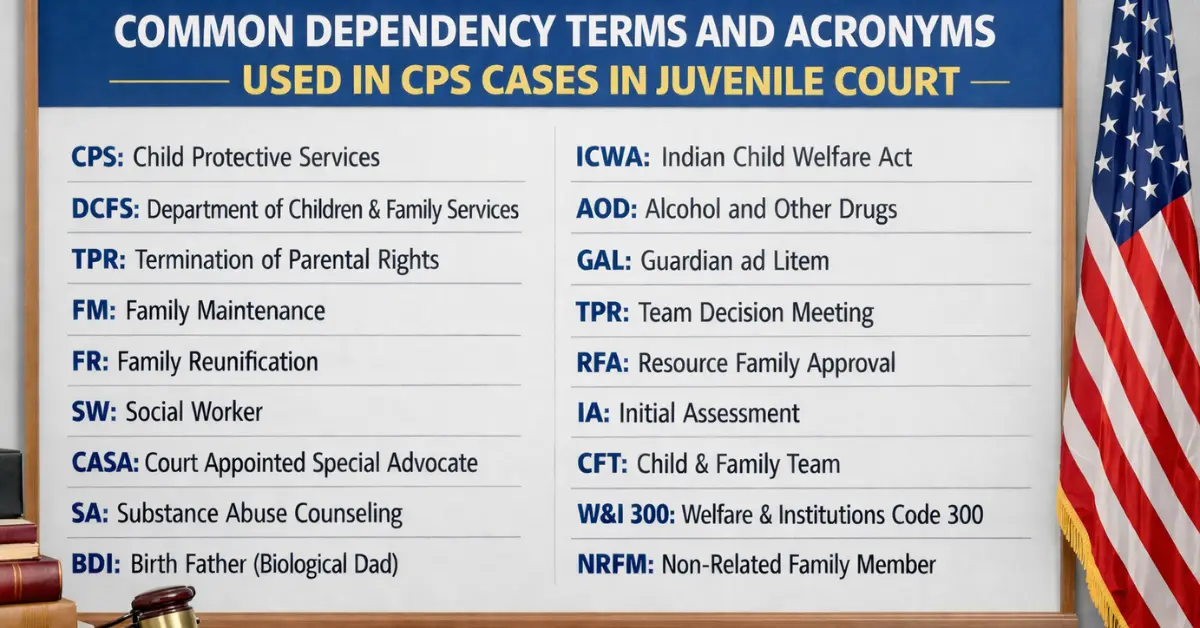
Common Dependency Terms and Acronyms Used in CPS Cases in Juvenile Court can often feel confusing and overwhelming, especially for parents who are involved in a Child Protective Services (CPS) investigation or a juvenile court dependency case. Legal professionals and social workers frequently use short terms and acronyms such as CPS, DSS, GAL, TPR, and ICPC, which can be difficult to understand if you are unfamiliar with the juvenile dependency court process.
In many child welfare cases, these terms appear in court documents, case plans, and hearings related to child custody, child protection investigations, parental rights, and family reunification. Understanding the meaning behind these commonly used legal terms helps parents better navigate the juvenile court system, communicate with caseworkers, and protect their legal rights during CPS proceedings.
Whether you are preparing for a dependency hearing, working with a family court attorney, or simply trying to understand documents related to a child welfare case, learning these key terms can make the process clearer and less stressful.
What is Juvenile Dependency Law?
Juvenile dependency law is designed to ensure child safety and protect children from abuse or neglect within the family.
Dependency cases are initiated when CPS intervenes to protect a child, often resulting in a dependency petition filed with the juvenile court.
Child Protective Services (CPS) plays a central role in assessing situations where child safety is at risk and managing the legal proceedings necessary to secure a child’s well-being.
The aim of dependency cases is not solely punitive; rather, they focus on providing parents with support and resources, helping families to safely reunite whenever possible.
The Department of Social Services (DSS) collaborates with CPS to offer various support services, and the juvenile court oversees cases, making critical decisions regarding the child’s welfare.
Duty of Care in Dependency Cases
In dependency cases, the duty of care is the legal obligation to act in the best interests of the child. For CPS, DSS, and court officials, this means thoroughly investigating allegations of neglect or abuse, ensuring the child’s safety, and providing families with the necessary resources to resolve issues.
This Duty of Care underscores every step of the dependency process, from filing the initial dependency petition to deciding on long-term custody arrangements.
Court-appointed professionals, such as the Guardian ad Litem (GAL) and Court Appointed Special Advocate (CASA), are tasked with representing the child’s best interests throughout the case, ensuring that all recommendations made to the court reflect the child’s safety, well-being, and future stability.
Importance of Legal Terminology in Juvenile Dependency
A clear understanding of the terminology used in juvenile dependency cases is essential for families, lawyers, and advocates involved. Misunderstanding terms can lead to confusion, miscommunication, and potential setbacks in achieving favorable outcomes.
Recognizing common terms and acronyms enables individuals to actively participate in their case, making informed decisions and better navigating the legal landscape.
Key Legal Terms and Acronyms in Juvenile Dependency Law
- Child Protective Services (CPS)
This agency is responsible for investigating allegations of child abuse and neglect and initiating court actions when necessary.
- Department of Social Services (DSS)
DSS provides essential support and services to children and families involved in CPS cases.
- Court Appointed Special Advocate (CASA)
A trained volunteer who represents the child’s interests in court.
- Guardian ad Litem (GAL)
A court-appointed individual who advocates for the child’s best interests.
- Termination of Parental Rights (TPR)
This legal action permanently ends a parent’s rights, typically when it is deemed that reunification is not in the child’s best interest.
- Indian Child Welfare Act (ICWA)
According to a federal statute, tribal ties are given priority when placing Native American children in foster or adoptive homes.
- Resource Family Approval (RFA)
A process to approve families for foster care placement, assessing their suitability as caregivers.
- Individualized Family Service and Education Plan
These plans address specific educational and developmental needs for children with identified challenges.
You also need: Understand Domestic Partnerships and Marriage
Common Court Procedures in Juvenile Dependency Cases
- Dependency Petition
The document filed to formally initiate a dependency case.
- Detention Hearing
A preliminary court hearing that occurs shortly after a child is taken into protective custody.
- Jurisdiction Hearing
A hearing to establish the court’s jurisdiction over the case and review evidence of abuse or neglect.
- Adjudication Hearing
The court evaluates the allegations and evidence to decide if the child is a dependent of the court.
- Disposition Hearing
A hearing to determine the necessary steps to support the child’s well-being.
- Permanency Planning Hearing (PPH)
A hearing to set long-term placement goals, prioritizing a stable home environment for the child.
Core Terms and Services Related to Family Reunification
- Child and Family Team (CFT) Meeting
A collaborative meeting to assess the family’s needs and develop a reunification plan.
- Family Service Plan (FSP)
Outlines the specific services and actions needed to address the issues that led to the dependency case.
- Reunification Services
Services provided to assist parents in resolving issues and safely reunite with their child.
- Substance Abuse (SA) Services
Support programs for parents struggling with substance abuse issues.
What Can Hiring a CPS/Child Welfare Attorney Do?
An attorney specializing in CPS cases can provide crucial support, helping families understand their rights and navigate complex legal procedures.
Legal representation can guide families through hearings, advocate on their behalf, and work towards the best possible outcome for both the child and the family.
Attorneys experienced in juvenile dependency cases bring an understanding of CPS operations, dependency laws, and court processes, ensuring parents and guardians have the information they need to make informed decisions.
Conclusion
Common Dependency Terms and Acronyms Used in CPS Cases in Juvenile Court are important for parents, guardians, and caregivers to understand when they are involved in a child welfare or dependency case. These legal abbreviations are commonly used by CPS caseworkers, juvenile court judges, attorneys, and guardians ad litem to describe different parts of the legal process.
Knowing what these acronyms mean can help families better understand court hearings, case plans, custody decisions, and parental rights issues that arise in dependency proceedings. It also allows parents to communicate more effectively with their family law attorney, social workers, and the court system.
By becoming familiar with these common CPS and juvenile court terms, families can approach the legal process with greater confidence and clarity, helping them make informed decisions while working toward child safety, reunification, or other court outcomes.