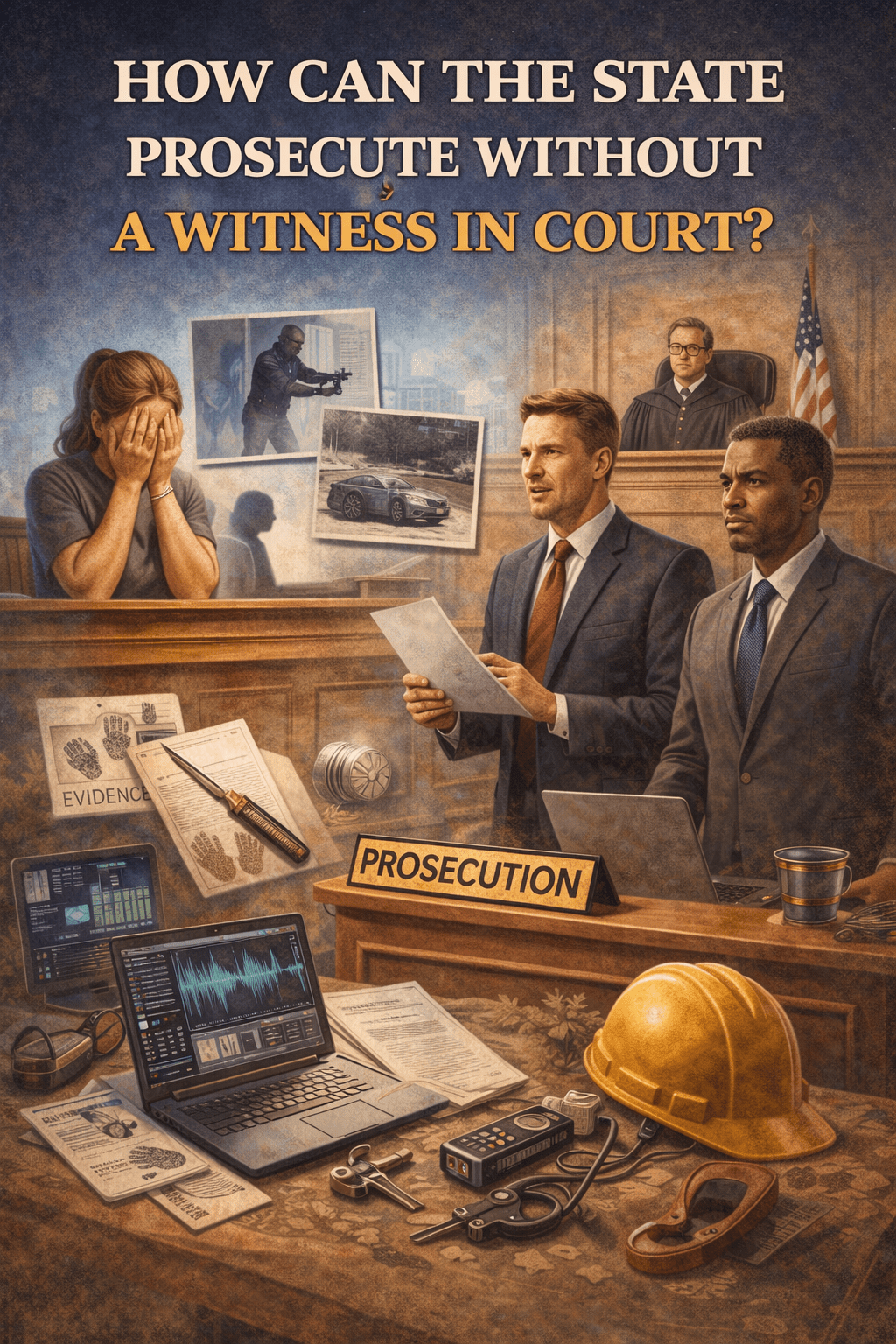
Many people assume a criminal case cannot continue unless a witness appears in court, but that is not always true. In some situations, the State Prosecute Without a Witness if there is enough evidence to support criminal charges. Prosecutors often rely on other forms of proof, such as police reports, surveillance footage, forensic evidence, recorded statements, or physical evidence collected during an investigation.
In criminal court proceedings, the prosecution’s goal is to prove the defendant’s guilt beyond a reasonable doubt, even if a key eyewitness refuses to testify or cannot be located. Domestic violence cases, assault charges, and certain felony investigations often move forward using alternative evidence, expert testimony, or prior statements. Understanding how prosecutors build cases without witnesses helps defendants and families better understand their legal rights, court procedures, and possible defence options when facing criminal charges.
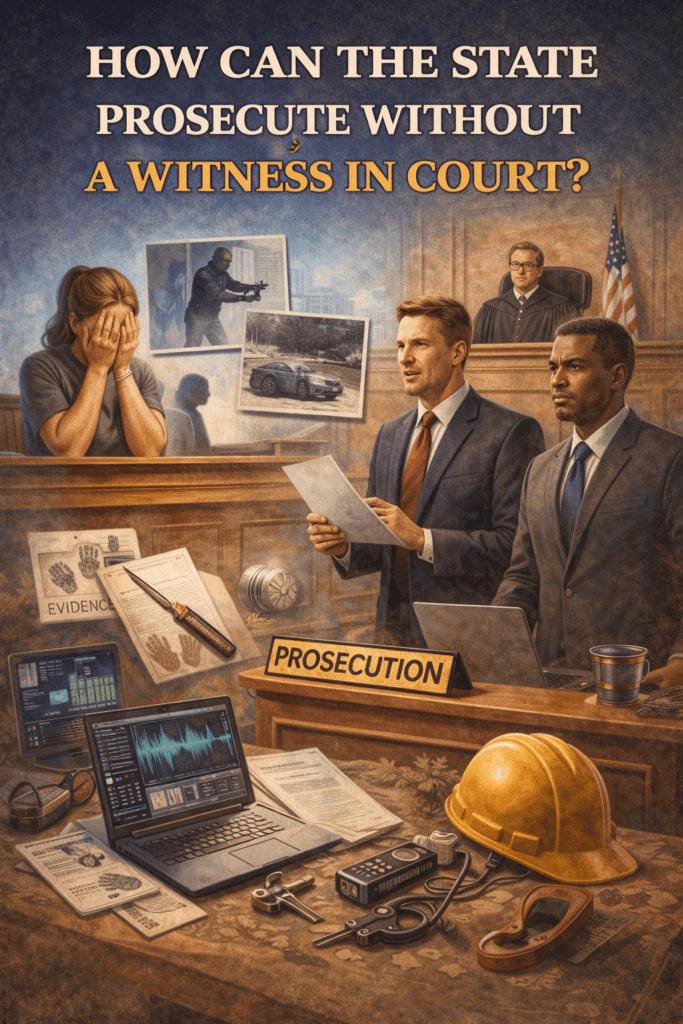
Table of Contents
Can the state prosecute without a witness
Witness testimony is fundamental in the prosecution of criminal cases. It helps establish facts and provides clarity about the events in question.
Jurors often rely on witnesses to assess the credibility of the evidence presented. For instance, eyewitness accounts can directly connect a defendant to the crime.
In many cases, the prosecution’s case hinges on the testimony of these witnesses, making their presence in court vital.
However, there are alternatives to witness testimony that can support a case. These include:
- Documents
Written records can serve as evidence, such as contracts, emails, or reports.
- Recordings
Audio or video recordings can provide valuable information about an incident, often compensating for a lack of eyewitnesses.
- Forensic Evidence
DNA, fingerprints, and other forensic materials can establish connections between the accused and the crime.
The legal system recognises that while witness testimony is important, it is not the sole method for building a case.
One major legal concept relevant to witness testimony is hearsay. Hearsay refers to statements made outside the courtroom that are not admissible as evidence during a trial.
Generally, hearsay is inadmissible because the person who made the statement is not present to be cross-examined. But this rule does have several exceptions, like:
- Prior Statements
If a witness made a statement earlier under oath, that statement might be admissible.
- Dying Declarations
Statements made by a person who believes they are about to die can sometimes be admitted as evidence.
Understanding hearsay and its exceptions is crucial for evaluating cases where witnesses may not be available.
In cases where witness testimony is lacking, the prosecution can rely on circumstantial evidence. This type of evidence indirectly supports a conclusion.
For instance, if a suspect’s fingerprint is found at a crime scene, it does not prove guilt directly but suggests a possible connection. Circumstantial evidence can build a compelling case when combined with other forms of evidence.
Courts have the authority to compel witness testimony through subpoenas. A subpoena is a legal document that requires an individual to appear in court and testify.
If a witness refuses to comply, they can face legal penalties. This mechanism ensures that witnesses who may have crucial information cannot evade the court process.
When a witness is unavailable, the legal system has procedures to handle the situation. This can include:
- Recorded Testimony
If a witness cannot attend the trial, their prior recorded testimony might be admitted.
- Depositions
A deposition involves taking sworn testimony from a witness outside of court, which can then be used during the trial.
These measures ensure that the absence of a witness does not automatically preclude prosecution.
Canadian law has its own rules regarding hearsay, which are similar to those in the USA. Although it is usually not admissible, hearsay is not always the case.
Courts in Canada recognise the necessity of certain statements, which may be admitted under specific conditions. Relevant case laws help define these exceptions and guide their application in trials.
In Canada, prosecutions can proceed using circumstantial or forensic evidence when witnesses are unavailable.
The legal framework allows for a strong reliance on physical evidence, which can often be as compelling as witness accounts. This flexibility helps ensure that justice is served even when witnesses are not present.
The process of compelling testimony in Canadian courts is similar to that in the USA. Courts can issue subpoenas to compel witnesses to testify, and penalties exist for those who refuse. This aspect of the law underscores the importance of witness testimony in both legal systems.
Several cases demonstrate the ability of the state to pursue prosecution without witness testimony. For instance, the case of State v. Cargill in Ohio involved a shooting where no eyewitnesses were available.
The prosecution relied heavily on circumstantial evidence and forensic analysis to establish a timeline of events. The defendant was ultimately convicted based on the strength of the evidence presented, even without direct witness accounts.
Similarly, in Canada, the case of R v. Pomerleau highlighted a situation where a murder conviction was secured without eyewitness testimony. Here, the prosecutor utilised DNA evidence and surveillance footage, leading to a successful conviction.
These cases have significantly impacted legal standards. The reliance on circumstantial evidence has encouraged courts to accept a broader definition of evidence in prosecution.
Legal precedents from such cases illustrate that juries can be instructed to draw reasonable inferences even when direct evidence is lacking.
Prosecutors face various challenges when attempting to secure a conviction without witness testimony.
One primary issue is the reliance on circumstantial evidence, which must be credible and compelling. In the absence of direct evidence, the prosecution must construct a narrative that logically connects the evidence to the crime.
Another challenge is dealing with the defence’s ability to challenge this evidence. Defendants can argue that circumstantial evidence is weak or incomplete, which may cast doubt on the prosecution’s case.
For example, in cases where the evidence consists mainly of circumstantial elements, the defence might successfully undermine the prosecution’s arguments.

Witness participation in court is essential, but many potential witnesses have questions about their role. Here are some common inquiries:
- Can you refuse to be a witness?
Generally, witnesses cannot refuse to testify if they are subpoenaed. If you don’t comply, there can be legal consequences.
- What happens if the state’s witness doesn’t go to court?
If a witness fails to appear, the prosecution may request a material witness warrant to compel their attendance.
- Do defendants have to testify?
No, defendants have the right not to testify. This decision is often strategic, as testifying can expose them to cross-examination.
- Who can prosecute in the US?
Prosecution is typically carried out by state or federal attorneys, depending on the jurisdiction and nature of the crime.
- What if the defendant’s attorney asks to talk to me?
Witnesses can decline to speak with defence attorneys unless they are comfortable doing so. Legal counsel can be sought to navigate these discussions.
- In front of the defendant, do I have to testify?
Yes, witnesses typically testify in the defendant’s presence during court proceedings.
Witnesses often have practical concerns regarding their participation, such as:
- For my time as a witness, will I receive payment?
Witnesses may be reimbursed for travel expenses, but compensation for time spent is less common.
- What if I fail to appear?
Failing to appear can lead to legal penalties, including fines or arrest.
- What about my employer?
Witnesses are typically entitled to take time off for court appearances, and employers cannot penalise them for fulfilling this civic duty.
- Who can be with me in court?
Witnesses may have support persons accompany them, but this varies by jurisdiction.
Victims and witnesses play critical roles in the criminal justice process. Victims have legal rights, including the right to be informed about the case’s progress and to participate in certain hearings. They may also be entitled to services such as counselling and legal assistance.
Court Appearances
Court cases are resolved through various stages, including initial hearings, trials, and appeals. Security measures are in place to protect all participants.
Witnesses should be aware of practical concerns, such as restrictions on electronic devices within the courthouse and the specific location of their hearings.
The criminal process begins with the filing of a criminal complaint, leading to an initial appearance and arraignment. Following these steps, the case may proceed to grand jury proceedings, where the evidence is reviewed to determine if there is enough basis for a trial.
During the trial, witnesses provide testimony that supports either the prosecution or the defence. The prosecution has the burden of proof, requiring them to present sufficient evidence to convince the jury of the defendant’s guilt.
Prosecution strategies may include the use of forensic evidence, expert testimonies, and documented communications. These types of evidence can significantly bolster the prosecution’s case when direct witnesses are unavailable.
Types of evidence that strengthen the prosecution’s case include:
- Forensic evidence (e.g., DNA, fingerprints)
- Digital evidence (e.g., emails, texts)
- Physical evidence (e.g., weapons, clothing)
Legal Summary & Guidance
Can the state prosecute without a witness? Yes, it is possible, but it remains challenging. The prosecution often relies on alternative forms of evidence, such as forensic data, circumstantial evidence, and recorded statements.
Both in the USA and Canada, legal systems have evolved to accommodate cases where witness testimony is absent, using strong evidence to build a case.
Although challenging, cases have shown that the state can prosecute without a witness, provided that the available evidence is compelling enough to support a conviction.