
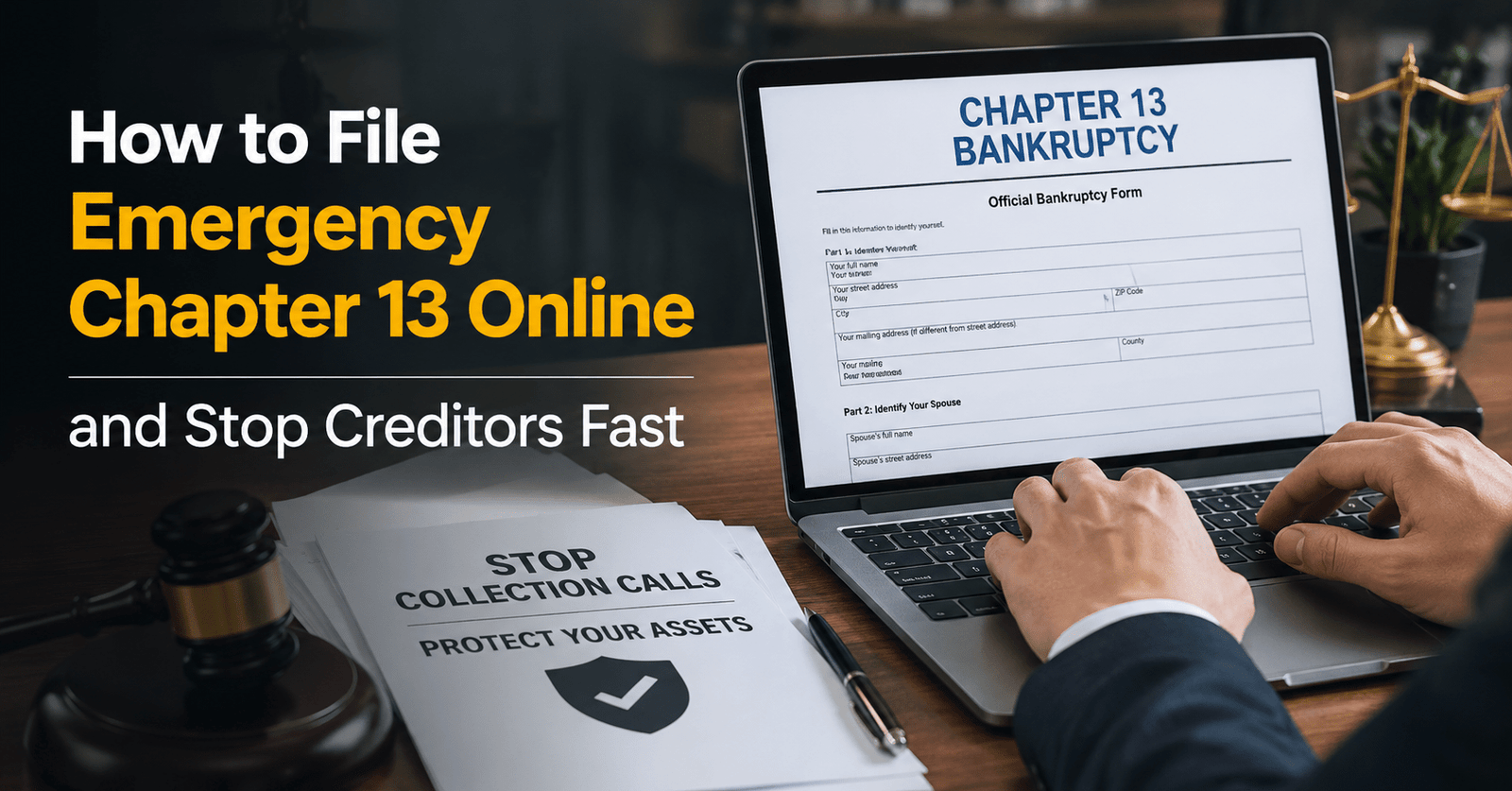
Your foreclosure sale is tomorrow. Your wages just got garnished. You found out about file emergency chapter 13 online at 11pm and now you’re trying to figure out if it’s even real. It is — and people use it every single day to stop creditors right before the deadline.
Here’s exactly how it works and what you need to do.
Wait, You Can Actually File Bankruptcy the Same Day?
Yes, and it happens more than you’d think.
It’s called a skeleton filing — you submit just enough paperwork to open your bankruptcy case. The court gives you a case number, and the moment that number is assigned, an automatic stay goes into effect. That stay legally forces creditors to back off. Foreclosures stop. Wage garnishments stop. Repossessions stop.
You then have 14 days to turn in the rest of your documents.
- The automatic stay kicks in the second your case number is issued, not when you mail in paperwork
- A foreclosure auction scheduled for tomorrow can still be stopped if you file today and get your case number in time
- The 14-day window gives you breathing room to pull everything else together
House Going to Auction Tomorrow — Is It Too Late?
Probably not, but today is the day.
Courts have cutoff times. If your auction is at 10am and you file at noon, you missed it. But if you file at 8am and the court processes your case before the auction, the sale gets halted. The lender’s attorney gets notified. The auctioneer has to stand down.
This isn’t a loophole. It’s exactly what the law allows.
- File first thing in the morning — don’t wait until afternoon
- Call the court clerk to confirm your case number was actually issued
- Contact your lender’s attorney with your case number the moment you have it
What Papers Do You Need for an Emergency Filing?
Less than you think — that’s the whole point of an emergency filing.
Most courts require four things to open a skeleton Chapter 13 case. That’s it. You do not need your full financial history, a complete repayment plan, or tax returns on day one.
- Voluntary Petition (Form 101) — your name, address, which chapter you’re filing, prior filings
- Creditor Matrix — names and addresses of everyone you owe money to
- Social Security Number Form (Form 121) — filed separately for privacy
- Credit Counseling Certificate — you can often complete this online in under two hours, or request a temporary waiver if time is truly impossible
The filing fee for Chapter 13 is $313. If you can’t pay it all upfront, ask for an installment plan. Some courts also want a local cover sheet — check your specific court’s website before you file.
Can You Do This Without a Lawyer?
You can, but Chapter 13 is not the easiest thing to do alone under pressure.
Some court districts offer an online tool called eSR (Electronic Self-Representation) that walks you through the petition with a step-by-step process. It’s free to use, available 24 hours a day, and doesn’t require you to download anything. If your district has it, it’s worth using.
The problem isn’t the emergency filing — that part is manageable. The problem is what comes next.
- Within 14 days, you have to file a full repayment plan, income and expense schedules, asset and liability lists, and a statement of financial affairs — all at once
- If you miss that deadline, the court dismisses your case and the foreclosure starts again
- A lot of bankruptcy attorneys will do an emergency filing within 24 hours and charge less than people expect, especially with a free consultation first
The 14-Day Deadline Is Not Optional
People file the emergency petition and then relax. That’s a mistake.
The automatic stay is in place, yes. But if you don’t submit the remaining documents within 14 days, the court throws out your case. The automatic stay disappears. Your creditors can go right back to where they were before you filed.
What you have to turn in within those 14 days:
- Full schedules of everything you own and everything you owe
- Income and monthly expense statements
- Proposed Chapter 13 repayment plan — this shows the court how you’ll catch up on missed payments over 3 to 5 years
- Statement of Financial Affairs
- Pay stubs from the past 60 days (cross out your Social Security number)
- Any local forms your court requires
If You’ve Filed Bankruptcy Before, Read This First
This trips people up constantly.
The automatic stay isn’t guaranteed if you’ve filed recently. Courts put a three-strike system in place specifically to stop people from filing over and over just to delay creditors.
- First filing in a year — you get a full automatic stay with no issues
- Second filing within a year of a dismissed case — your stay only lasts 30 days; you must file a Motion to Extend the Stay immediately or you lose it
- Third filing within a year — there is no automatic stay at all unless you file a Motion to Impose the Stay and convince a judge you’re acting in good faith
If this is your second or third filing, talk to an attorney before you file. The automatic stay won’t protect you the same way, and a creditor can keep going even after your case is open.
Why Chapter 13 and Not Chapter 7?
Chapter 7 wipes out debt faster, but it doesn’t fix a mortgage problem.
Chapter 13 was built for people who want to keep their home. If you’re behind on payments, it lets you catch up on everything you owe over a 3 to 5 year plan while keeping up with your regular monthly payments going forward. The court supervises the whole thing. Creditors can’t touch you while the plan is active.
- You stop foreclosure and pay back missed mortgage payments over years, not all at once
- Your car, your wages, and your home are all protected under the automatic stay
- Once you complete the repayment plan, remaining eligible debts can be discharged
Further reading:
Submit a Petition to the Court
Legal Guidance
Don’t sit on this. The automatic stay only protects you after your case number is issued — not after you fill out the form, not after you submit it, only after the court processes it and assigns you a number.
Check your local bankruptcy court’s website right now, find the emergency filing requirements for your district, and start on the Voluntary Petition. That’s the first form. Start there.
If you’re not sure whether to file alone or get an attorney, call a few — many offer free consultations and can tell you in 15 minutes whether your situation is something they can handle quickly.