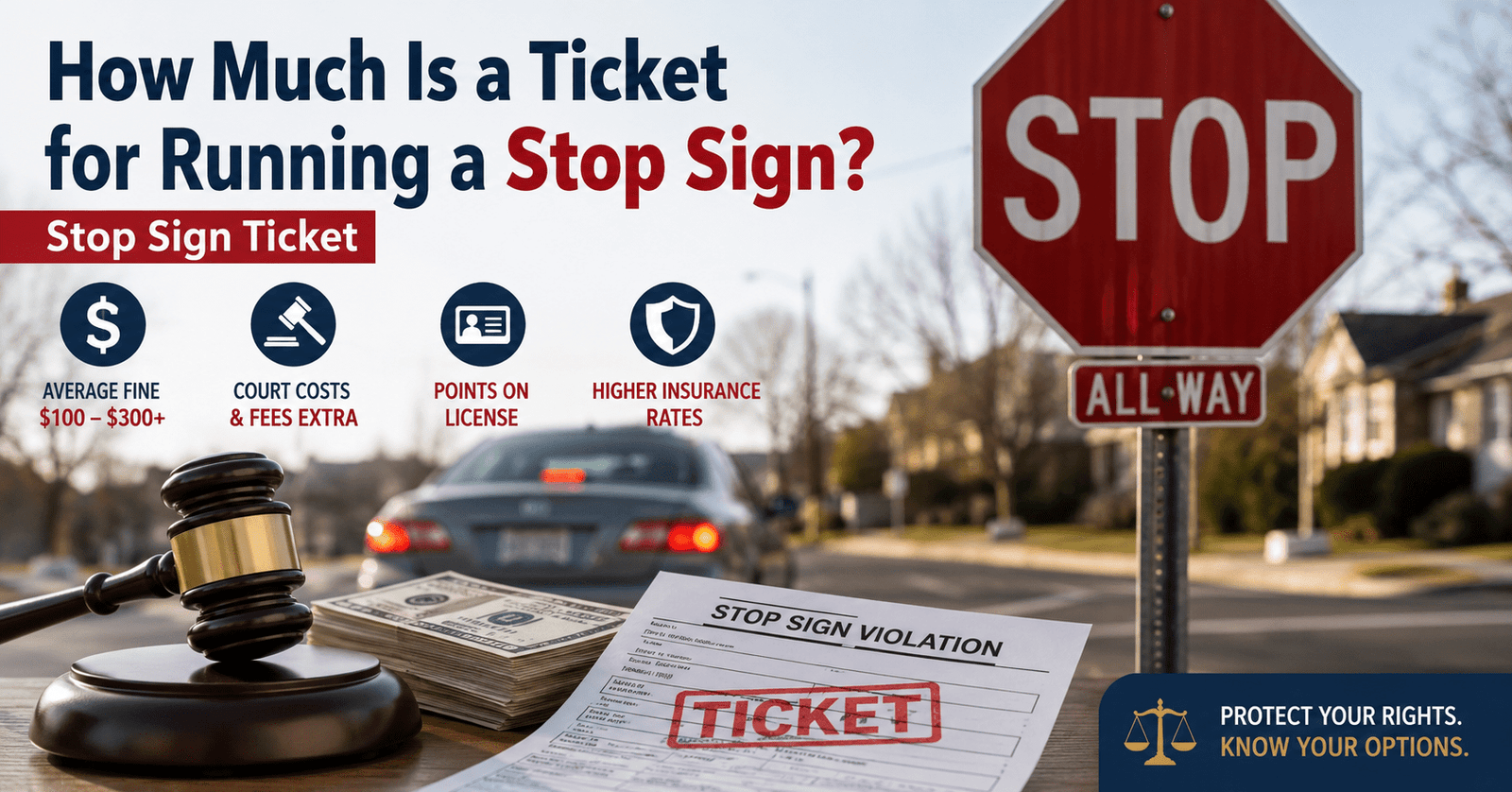
Nobody budgets for a traffic ticket. You make a split-second call at an intersection, a cruiser lights up behind you, and suddenly your afternoon takes a hard left turn. How much is a ticket for running a stop sign ends up being the first thing you search once you pull over — and the answer is genuinely more complicated than a single number. What’s printed on the citation is just the floor, not the ceiling. Courts pile fees on top. The state adds its own charges. Then three weeks later your insurance bill arrives and something feels off. That one moment at the stop sign now has a very long financial tail.
- The printed fine on your citation is the starting point — local court fees and state surcharges routinely push the real total 50–100% higher
- School zone stop sign violations are treated differently by law — penalties are typically doubled automatically, not at anyone’s discretion
- Paying the ticket without appearing in court isn’t “taking the easy way out” — it’s a legal guilty plea with lasting consequences
- Miss your court date entirely and the situation escalates fast — arrest warrants get issued and new fees attach to your case
Repeat violations within a short period are treated more harshly — courts have room to go beyond standard fine schedules
Table of Contents
How Much Is a Ticket for Running a Stop Sign in the U.S.?
Giving you one clean national number would be misleading, so here’s what actually happens. Most drivers who go through the full process — citation, court fees, administrative charges — end up somewhere in the $150 to $500 range depending on location. Texas tends to be cleaner about it than most states. The total for a stop sign violation there runs around $286, and that number genuinely covers everything — court costs are already built in, so the amount you see is the amount you owe. California works differently. The state runs your base fine through a penalty multiplier system that stacks assessment after assessment until a $100 fine becomes nearly $500. It catches a lot of drivers completely off guard.
- Texas — around $286 total, transparent pricing, no hidden additions waiting at the courthouse
- California — deceptively low base fine, but the penalty assessment multipliers push totals to $490 and beyond
- New York — wide variation by county, but most drivers see $150 to $400 when all is said and done
- Florida — middle-of-the-road pricing, typically $200 to $300 with fees included
- Illinois — base fine looks reasonable at around $150, but the final number after fees usually clears $250
Where Do Stop Sign Fines Vary Most by State?
Geography matters more than most drivers realize when it comes to traffic fines. The state sets a legal framework, but your local court fills in a lot of the blanks — and courts in different cities charge very different rates for identical infractions. A driver ticketed in downtown Atlanta pays more than someone who picked up the same violation in a small Georgia county an hour outside the city. That gap can stretch into hundreds of dollars. The table below reflects realistic totals based on typical fee structures, but calling your specific court directly always gives you the most accurate number.
| State | Realistic Total After Fees |
| Texas | ~$286 |
| California | $238–$490+ |
| New York | $150–$400 |
| Florida | $200–$300 |
| Illinois | $200–$300 |
| Georgia | $150–$500 |
| Arizona | $250–$350 |
- Smaller rural courts almost always charge less than big-city courts — same violation, meaningfully different bill
- Some cities tack on a dedicated traffic safety fund contribution that never appears on the original citation
- Online payment portals charge a processing fee on top of everything else, usually 2–4% of the total
- The school zone fine doubling isn’t a judgment call — it’s written directly into state statute in most jurisdictions
- Drivers in Temecula, California need to account for California’s multiplier system — totals there regularly exceed $490
Do Stop Sign Tickets Add Points to Your Driving Record?
They do, and this is where the long-term damage really lives. You write a check and the fine goes away. The points on your license don’t. They sit there quietly — one, two, three points depending on your state — and they wait. If you stay clean, they fade after two or three years. If you pick up another moving violation before they drop off, they stack. States set thresholds, and once you cross them, the consequences shift from financial to something more serious — mandatory hearings, required courses, or suspension. Drivers in Texas who want a clear picture of their current standing can request their history directly from the Texas Department of Public Safety (Texas.gov) before deciding how to respond to their ticket. Knowing your point total changes the math on whether fighting the citation is worth it.
- One to three points per stop sign violation is the norm across U.S. states
- Points typically linger for two to three years — in some states the window stretches to five
- Texas commercial license holders have no access to the defensive driving dismissal path — the law specifically excludes CDL drivers
- Accumulating six to twelve points within a single twelve-month window puts your license itself at risk in most states
- Point reduction programs through approved courses exist in several states, but they have hard deadlines — miss yours and the option closes
How Do You Actually Fight One of These Tickets?
Most people assume fighting a traffic ticket is complicated, expensive, or pointless. In practice, none of those things are reliably true. Officers write a lot of tickets, and the written record they create at the scene isn’t always complete or accurate. Dates get wrong. Vehicle descriptions don’t match. More importantly, the officer’s physical position when they observed your vehicle matters enormously — if they were far away, behind traffic, or at a difficult angle, their certainty about what happened is genuinely questionable. Visibility of the sign itself is another strong angle. A stop sign obscured by branches, tilted by a previous accident, or posted in a non-standard location gives you something real to work with. The formal starting point for challenging a ticket is to Submit a Petition to the Court — this needs to happen before your appearance date, not after.
- Request a hearing before doing anything else — once you pay, you’ve pled guilty and the door closes
- Ask the court to provide the officer’s written notes and any available traffic camera footage while it’s still accessible
- Visit the intersection yourself and document current conditions — photograph the sign, its visibility, and sight lines from multiple angles
- Traffic attorneys handle these cases regularly and often charge flat fees lower than the ticket itself — their court relationships alone are worth it in many jurisdictions
- Deferred adjudication programs let you avoid a conviction entirely — pay a reduced processing fee, stay violation-free for a set period, and the charge doesn’t follow you
Will a Stop Sign Ticket Drive Up Your Insurance?
Yes — and the increase typically lasts longer and costs more in total than the original fine. Insurance companies don’t view a stop sign ticket as a minor administrative matter. It registers as a moving violation, which shifts your risk classification upward. Actuaries run the numbers, and the result tends to be a 10% to 25% annual premium increase. What makes this genuinely painful is the timeline. Most insurers look back three years when pricing a renewal. A $300 annual increase across that window adds up to $900 in extra premiums — from a violation that may have cost you $286 to pay. Preventing the violation from reaching your record in the first place, through a qualifying driver safety course or successful court challenge, is the financially smarter path by a significant margin.
- Expect your annual premium to climb $200 to $500 once the violation posts to your record — exact amount depends on your insurer and prior history
- A clean driving record before this helps, but it doesn’t protect you completely — first violations still trigger increases at most companies
- Some insurers carry a first-offense forgiveness provision buried in their policy terms — a direct phone call to your agent before renewal is worth making
- Successfully completing a court-approved DSC or driver improvement course keeps the violation away from your insurer’s data entirely
- Once rates rise, compare quotes from other carriers — insurers price moving violations differently, and switching can recapture some of the increase
FAQs:
How much is a ticket for running a stop sign?
Once your local court adds its fees and surcharges on top of the base penalty, most drivers across the U.S. pay somewhere between $150 and $500. Your state sets the framework, your specific court fills in the rest, and factors like school zone location push the number higher.
How much is a ticket for running a stop sign in Texas?
In Texas the total comes to roughly $286, and that figure already accounts for court costs — there’s no second surprise when you go to pay. It’s one of the more straightforward states on this front.
How much is the ticket for running a stop sign in Temecula?
Temecula falls under California’s penalty assessment system. What starts as a base fine of $100 to $238 gets multiplied through the state’s assessment structure, and the final bill routinely lands above $490.
How much is a ticket for running a stop sign if I pay online without going to court?
You pay the listed amount plus a processing fee — but the bigger issue is what that payment represents legally. It’s a guilty plea. The violation goes on your record, and your insurance company accesses that information at your next renewal.
Can I get a stop sign ticket dismissed?
Quite often, yes. The most common paths are completing a state-approved defensive driving course, presenting documentation that the stop sign was obstructed at the time of the offense, or showing proof of valid insurance that was active on the date of the citation. If additional charges appear alongside the traffic violation — particularly in Texas where something like Texas criminal harassment law could intersect with a traffic stop in unusual circumstances — getting a local attorney involved before your court date is the right call.
Legal Guidance
How much is a ticket for running a stop sign? The bill most drivers actually pay runs between $150 and $500 once fees are fully counted — but that figure captures only part of the real cost. License points that accumulate quietly. Insurance premiums that climb for three years. A potential court warrant if the ticket is ignored. These are the consequences that outlast the fine itself. The good news is you have meaningful choices: contest the ticket, complete a qualifying safety course, explore deferred adjudication, or at minimum understand what happens to your record before you pay anything. The drivers who come out of this situation best are the ones who slowed down and thought before reaching for their checkbook.