
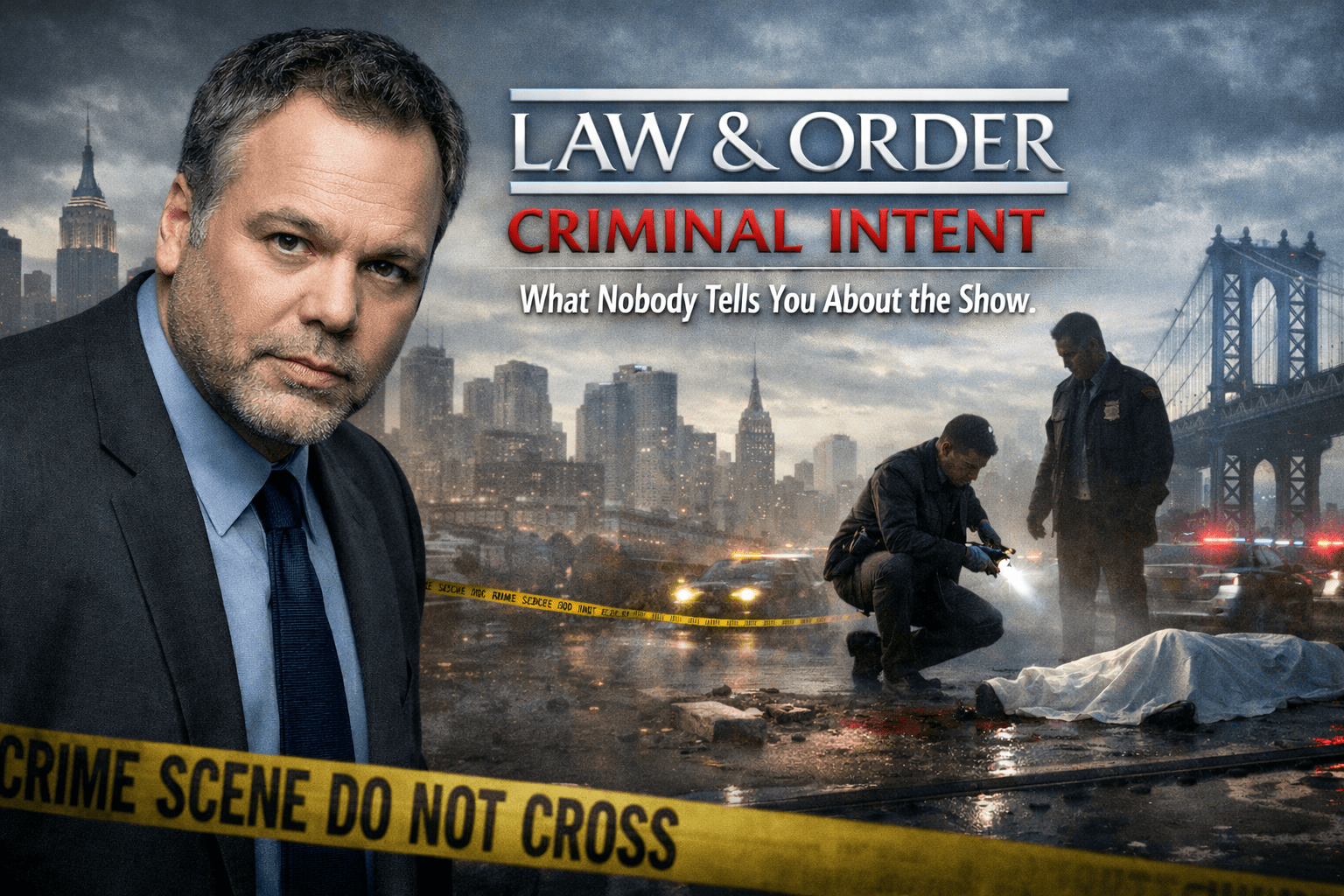
Okay so here’s something I genuinely didn’t expect to spend an afternoon down the rabbit hole on. I went looking for a solid article about Law and Order Criminal Intent — just the real deal, something with some depth — and every single page I found was the same. Episode counts. Cast lists. Streaming links. Maybe a paragraph about Detective Goren’s head tilts if you were lucky.
Nobody was actually talking about the show.
Like — why did the whole cast structure suddenly change in Season 5? What actually happened with NBC? Why does the early footage look so different from later seasons? How did the two lead actors survive doing what was essentially a two-person Broadway show, 22 episodes a year, for four straight years?
That’s the stuff worth writing about. So here it is.
First, What Made This Show Actually Work
Law and Order Criminal Intent premiered September 30, 2001 — which, if you do the math, is three weeks after 9/11. New York was still raw. And this show set in New York, about a police squad dealing with the city’s darkest crimes, somehow found an audience immediately.
Dick Wolf created it alongside René Balcer, and the premise was genuinely clever. The Major Case Squad handled high-profile, complicated crimes — the kind involving politicians, Wall Street people, old money, celebrities. Not random street crime. The crimes where the killer had resources and motive and usually a decent lawyer.
But the format is what really set it apart. Most crime shows spend the whole episode hiding the killer from you. Criminal Intent often showed you the killer in the first five minutes. The whole episode then became about watching Detective Goren figure out how to prove it. It’s a completely different kind of suspense — less thriller, more chess match. And Vincent D’Onofrio played Goren like nobody else would have dared to.
The show was pulling 15.5 million viewers in its early seasons. It was beating The Sopranos on Sunday nights. That’s not a footnote — that’s a dominant TV show.
The Part That’s Actually Kind of Disturbing to Read About
I want to be honest — when I first read about the filming conditions on this show, I had to go back and check the source. It sounded extreme even by old-Hollywood standards.
For the first four seasons, Vincent D’Onofrio and Kathryn Erbe were doing 22 episodes a year almost entirely on their own. The original Law & Order had a rotating ensemble — multiple detectives, multiple lawyers, shared load. Criminal Intent had two people. For 22 episodes. A year.
D’Onofrio has talked about averaging 17 hours a day, every day, for 10 months a year. He’s been clear that he hated it and is genuinely relieved those schedules aren’t allowed anymore. But the worst of it came during Season 4. He lost two family members during production. The show didn’t give him time off to attend one of the funerals. He’s described that period as the rock bottom of his life — not just his career, his life.
Kathryn Erbe’s described her schedule as unbearable. She’d wrap on a Friday night, get home Saturday morning when the sun was already up, see her kids for a few hours, and then spend Sunday memorizing the next week’s dialogue. Dense, technical, police-procedural dialogue. Then Monday would come and it started again.
This is why Season 5 brought in Chris Noth as Mike Logan and Annabella Sciorra as his partner. You’ll read a lot of places that it was a “creative decision” to split the show’s caseload. That’s technically true. But the actual reason was that two human beings were being ground down by an impossible workload and the production needed to do something before one of them collapsed.
Which, by the way — D’Onofrio did collapse on set. Twice in one week, reportedly from exhaustion. That’s not a creative decision. That’s an emergency.
Read more: What Happens If You Drive Without Insurance
Goren Was the Star. Eames Was the Show.
Everyone who watched this show remembers Goren. The way he’d lean into someone’s space until they got uncomfortable. The non sequitur observations that somehow cracked the case open. The weird encyclopedic knowledge that felt less like detective work and more like a parlor trick. D’Onofrio built something genuinely original there.
But Kathryn Erbe’s Alexandra Eames doesn’t get nearly enough credit, and I’d argue she was the more important character for the show’s survival.
Goren, on his own, would have been exhausting to watch. Brilliant but unmoored. Eames was the reason you trusted him — she reacted to him the way a reasonable person would, which let the audience calibrate. She had her own quiet backstory: her husband was a cop killed on duty. She didn’t perform that grief. It just lived in her, and Erbe let it surface only when the story demanded it, which made it hit harder every time.
The evidence for how essential she was? When the show started rotating in new detective pairs in later seasons — Jeff Goldblum’s Nichols, various others — the ratings went down. Not a little. Significantly. Viewers weren’t just tuning in for the Major Case Squad concept. They were tuning in for these two specific people. You can’t swap that out.
The Network Drama Nobody Covers Properly
In May 2007, NBC had a problem. It had two Law & Order shows and could realistically afford to keep one of them. The original Law & Order had just had a decent ratings stretch in its 17th season. Criminal Intent’s numbers had been sliding. NBC kept the original and moved Criminal Intent to USA Network.
That’s the version of events everyone knows. Here’s what gets left out:
The 2007 Writers’ Strike hit while Season 7 was still in production. Filming stopped entirely. The season had to be finished and then held until USA could air it — the remaining episodes didn’t start running until June 2008. Nearly a year after they were partially filmed.
And when the show finally moved to USA, they changed the theme music. The version that had opened every episode on NBC was replaced with the theme from Law & Order: Trial by Jury — a spin-off that had been cancelled after 13 episodes. It’s a small detail but it’s the kind of thing that tells you how the network was thinking about this show by that point.
The show eventually ended after Season 10 in 2011. USA chose not to renew it due to costs. Dick Wolf had been hoping for an 11th season — he was publicly optimistic right up until the cancellation. It didn’t happen.
It Went Global. Quietly.
This is the part that I find most interesting and that I’ve never seen covered in any English-language piece about the show.
Criminal Intent wasn’t just an American show. The format was sold internationally and adapted in three different countries.
France got a version in 2005 — NBC Universal sold the rights to TF1, and a Paris-set adaptation ran for 20 episodes over three seasons between 2007 and 2008. Same premise, French cast, adjusted for Parisian setting and culture.
Russia launched its version in March 2007, airing back-to-back with a Russian SVU adaptation. It became one of the country’s top-rated series almost immediately. The original order was 8 episodes. It ended up running to around 40.
And most recently — February 22, 2024 — a Canadian version called Law & Order Toronto: Criminal Intent premiered on Citytv. The CW has already ordered two seasons. Season 2 is expected in 2026. The franchise is still expanding. It’s just doing it quietly enough that most people have no idea.
Read more: Cost for Traffic Attorney
Why the Show Looks So Different Across the Seasons
If you’ve gone back and watched the early episodes recently, you’ve probably noticed how different they feel visually. Cold. Dim. That particular shade of tired fluorescent light over everything.
That wasn’t budget constraints. It was a deliberate choice. The first five seasons were shot on 3-perf 35mm film with intentionally low lighting — they wanted that drab, slightly oppressive visual atmosphere. It matched the psychology of the show.
In Season 6 they brightened the lighting on set. Then in Season 9 the production switched entirely from film to digital video, which changed the texture of everything. They also physically modified the squad room — pulled out sections of the ceiling, added warmer incandescent strips — to make the space feel less institutional.
So when you’re watching Season 2 and then jump to Season 9 and think “wait, does this feel like a different show?” — you’re not imagining it. It is, technically, a different show. Same characters, same premise, completely different visual DNA.
The Episode That Got Too Close to Real Life
Criminal Intent, like all the Law & Order shows, pulled from real headlines constantly. But there’s one episode worth singling out.
Season 7, 2008. An episode called “Contract.” It features a powerful Hollywood producer — blackmail, abuse of power, industry secrets. The character is described and depicted in ways that, when viewers went back and rewatched it after 2017, felt uncomfortably specific. The Harvey Weinstein scandal broke publicly that year. The episode had aired nine years earlier.
Could be coincidence. Could be that certain open secrets were open enough that writers in 2008 were drawing from them without realizing how close they were getting. Either way it’s one of those TV moments that lands differently depending on when you watch it.
On a lighter note — Season 1 of Criminal Intent actually featured guest appearances from original Law & Order cast members including Jerry Orbach, Jesse L. Martin, S. Epatha Merkerson, and J.K. Simmons, all playing their original characters. It was a nice way of establishing that this was the same world, not just a rebrand.
So Why Does It Still Hold Up?
195 episodes. 10 seasons. Still streaming on Peacock. Still airing reruns. Still generating arguments online about which Goren episode is the best one.
I think the honest answer is that Criminal Intent trusted its audience more than most procedurals did. It wasn’t hiding the killer from you to manufacture suspense. It was asking a harder question: given everything you know about this person, watch these detectives figure out how to make a case. And underneath that — why do people end up here? What’s the thing that tipped them over?
That’s not procedural TV. That’s psychological drama wearing a procedural costume. And it’s genuinely rare.
D’Onofrio put it well in an interview a few years back: “I left that show a better actor than I was when I went in.” Given what he went through to make it — the hours, the personal losses, the physical collapses — that’s either a remarkable piece of perspective or a remarkable piece of stubbornness. Maybe both.Either way the show exists. It ran for a decade. And whatever the behind-the-scenes reality looked like, what ended up on screen was something that a lot of people still haven’t forgotten — and are still, apparently, searching for. Not bad.
Legal Guidance
Law and Order Criminal Intent is not your typical crime show. Instead of focusing only on “who did it,” the series dives deep into why criminals commit crimes. The show follows elite detectives, especially Vincent D’Onofrio as Detective Robert Goren, who uses psychology and sharp observation to break suspects mentally.
What many people don’t realize is that the show often reveals the criminal early in the episode. This flips the usual mystery format and makes it more about mind games, motives, and interrogation tactics rather than simple clues.
Another hidden aspect is how intense and different Goren’s character is. His unusual behavior, deep thinking, and emotional approach make the show feel darker and more realistic compared to other Law & Order series.
In short, Criminal Intent stands out because it focuses on the criminal’s mindset, strong character-driven storytelling, and powerful psychological drama—things casual viewers often overlook.