

A Contempt Motion in Court is a serious legal step taken when someone disobeys a judge’s order or shows disrespect toward the court. It can lead to fines, penalties, or even jail time. Many people do not fully understand how powerful this legal action can be. Whether it involves court order violation, civil contempt, or criminal contempt, the consequences can affect your rights, reputation, and freedom. Before filing or responding to such a motion, it is important to understand how the legal system handles non-compliance, what evidence is required, and how judges make decisions in these cases.
Understanding the Purpose of a Motion for Contempt
The primary purpose of a Motion for Contempt is to ensure accountability and compliance with court orders. In family law, compliance is crucial as the terms directly impact family dynamics, the welfare of children, and the financial stability of parties involved.
When one party disregards a court order, they not only compromise the other party’s rights but also challenge the authority of the court itself.
Contempt motions are also a way for the judicial system to protect its rulings, which hold legal weight to resolve disputes fairly.
By holding non-compliant parties accountable, the court affirms its role in enforcing adherence and preserving legal rights for all involved parties.
This compliance is often achieved through coercive measures, penalties, or, in more severe cases, imprisonment.

Types of Contempt in Family Law
In family law, contempt cases fall into two main categories: civil contempt and criminal contempt. These types serve different purposes and apply in various scenarios.
- Civil Contempt
This is generally coercive and is intended to encourage compliance with a court order. For example, if a parent fails to make scheduled child support payments, the court can issue a civil contempt order requiring them to pay or face penalties.
- Criminal Contempt
Criminal contempt is punitive and is used when the court determines that a party has willfully disregarded an order. This type is less common in family law but can apply in cases where a party’s defiance is particularly egregious, such as openly disregarding a custody order.
| Type | Purpose | Example |
|---|---|---|
| Civil Contempt | Coercive; enforces compliance | Failing to pay child support |
| Criminal Contempt | Punitive; punishes willful disobedience | Refusal to adhere to custody orders |
Common Grounds for Filing a Motion for Contempt
Typical Grounds for Filing a Motion for Contempt in family law include:
- Failure to Pay Child Support
When a parent neglects their financial responsibilities, the other parent may file a contempt motion to enforce the order.
- Violation of Custody Agreements
Refusing to allow visitation rights or making unilateral decisions about the child’s upbringing are common reasons for contempt.
- Refusal to Follow Property Division Orders
In divorce cases, ignoring property division instructions set by the court can lead to a contempt motion.
Supporting evidence requirements include financial records, written communication, and witness testimonies, all of which strengthen the contempt claim. These pieces of evidence serve as proof of non-compliance and support the complainant’s motion in court.
The Legal Process for Filing a Motion for Contempt
The process for filing a Motion for Contempt follows a series of legal steps:
- Preparing Required Documents
The complainant must gather relevant documentation supporting the contempt claim, such as financial records, custody agreements, or other court orders.
- Submitting the Motion
When the paperwork is ready, it is submitted to the court. In some jurisdictions, this requires specific forms tailored to family law cases.
- Notification Process
The opposing party is notified, allowing them to respond or attend a court hearing to present their side of the case. This guarantees that each party has the chance to be represented and provide input.
- Court Hearing
During the hearing, the judge reviews the evidence, listens to both parties, and determines if contempt exists. If so, the court may issue an order requiring compliance or impose penalties.
These procedural steps vary slightly by state and jurisdiction, but they are designed to ensure a fair and thorough examination of the case while respecting the rights of all parties involved.
Potential Court Decisions in a Contempt Motion
When a motion for contempt is filed, the court assesses the severity of the non-compliance and can issue several outcomes:
- Ordering Compliance
The court’s main objective is frequently to force the noncompliant party to follow the terms of the original agreement. This could mean a parent resuming child support payments, or someone fulfilling the terms of a property division order.
- Imposing Fines or Penalties
In cases where a simple compliance order isn’t enough, the court may impose fines as a punitive measure. For instance, a person who fails to pay spousal support might face monetary penalties to deter future violations.
- Jail Time for Non-Compliance
For severe violations, jail time might be imposed. This generally happens when a person repeatedly disobeys court orders, showing a disregard for the court’s authority. Both civil and criminal contempt cases can lead to incarceration, although it’s usually a last resort in family law cases.
- Alternative Resolutions
In some situations, the court may suggest mediation as a way to resolve underlying issues that might be causing non-compliance. A judge might propose this if the parties show a willingness to work together or if a collaborative resolution could yield a lasting solution.
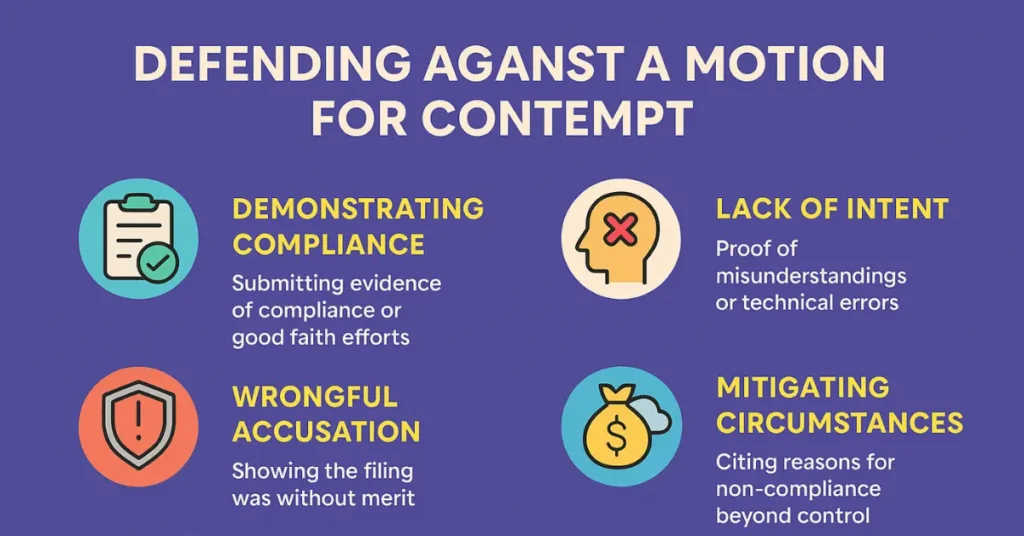
Defending Against a Motion for Contempt
If faced with a motion for contempt, individuals have various defenses available, depending on the circumstances:
- Demonstrating Compliance
A defendant can argue that they have been in compliance with the court order or that any deviations were minor and rectifiable. Submitting evidence of compliance or good faith efforts can strengthen this defense.
- Lack of Intent
Courts may be lenient if the individual can demonstrate that they did not intend to violate the court order. Proof of lack of intent, such as misunderstandings or technical errors, may sway the court’s ruling in their favor.
- Wrongful Accusation
Sometimes, a motion for contempt might be filed without merit. If an individual believes they have been wrongly accused, they can defend themselves by proving that they fulfilled their obligations or that the filing was unwarranted.
- Mitigating Circumstances
Factors beyond a defendant’s control, such as a sudden financial crisis, can be cited as reasons for non-compliance. Courts often consider these mitigating factors before issuing sanctions.
- Legal Counsel and Right to Appeal
Having strong legal counsel is crucial in defending against contempt actions. A good attorney can build a robust defense and, if necessary, pursue an appeal to seek a more favorable outcome.
Enforcing Compliance After a Contempt Ruling
Once a court issues a ruling for contempt, there are various ways to enforce compliance:
- Wage Garnishment
If the contempt involves unpaid child support or spousal support, the court may order wage garnishment to ensure payments are made directly from the individual’s income.
- Liens and Asset Seizure
Courts can place liens on property or seize other assets to cover outstanding debts resulting from non-compliance. This is often used in cases involving substantial unpaid support or alimony.
- Modifying Visitation Rights
In custody cases, non-compliance can result in modifications to visitation rights. A parent who repeatedly fails to honor court-ordered visitation schedules, for instance, might have their visitation privileges restricted.
- Community Service or Additional Penalties
In some cases, courts might require community service or issue other penalties as a form of restitution. This type of enforcement is more common in criminal contempt cases, where punitive actions are prioritized.
Legal Summary & Guidance
Understanding how a contempt case works can protect you from serious legal trouble. Courts treat failure to comply with a court order very strictly, especially in matters involving family law disputes, child support enforcement, or restraining order violations. Filing the correct paperwork, presenting clear proof, and knowing your legal defenses are critical steps. If handled properly, you can protect your legal rights and avoid unnecessary penalties. Always consider seeking guidance from a qualified attorney when dealing with legal penalties, court hearings, and judicial enforcement actions.