Child custody decisions are some of the most important outcomes of divorce or separation cases. A well‑designed custody arrangement helps children feel safe, supported, and emotionally secure during a difficult transition. In the United States, courts focus on one primary goal: the best interests of the child.This guide explains the most common Custody Plan Types, how they work, and what parents should consider when choosing the right plan.
Courts prioritise the best interests of the child, weighing factors such as parental fitness, the child’s attachment to each parent, and any history of abuse or neglect. Let’s explore the most common types of custody plans in the U.S.
Table of Contents
What Are Custody Plan Types?
Custody plan types describe the legal and practical structure used to divide parenting time, responsibilities, and decision‑making authority between parents. These plans outline:
- Where the child will live
- How parenting time is shared
- Who makes major life decisions
- How parents communicate and resolve disputes
Courts may approve a plan agreed upon by both parents or impose one if parents cannot reach an agreement.
Why Custody Plans Matter for Children
Custody plans are not just legal documents—they shape a child’s daily life. A strong custody plan:
- Creates stability and routine
- Reduces conflict between parents
- Helps children adjust emotionally
- Encourages healthy relationships with both parents
Judges carefully review custody plan types to ensure children are not exposed to instability, neglect, or emotional harm.
Physical Custody: Where the Child Lives
Physical custody determines the child’s primary residence and daily care. This is one of the most common custody plan types considered by courts.
Sole Physical Custody
Sole physical custody means the child lives primarily with one parent. The other parent usually receives visitation rights.
When it is used:
- One parent cannot provide a stable home
- Long‑distance living arrangements
- Safety or neglect concerns
Pros:
- Consistent routine for the child
- Clear responsibility structure
Cons:
- Limited time with the non‑custodial parent
- Emotional distance may develop
Joint Physical Custody
Joint physical custody allows the child to live with both parents for significant portions of time. This is one of the most widely used custody plan types today.
Pros:
- Strong bonds with both parents
- Shared parenting responsibilities
Cons:
- Requires strong communication
- Can be stressful if parents live far apart
Legal Custody: Decision‑Making Authority
Legal custody focuses on who makes major decisions about the child’s life, including education, healthcare, and religious upbringing.
Sole Legal Custody
One parent has full authority to make important decisions.
Common reasons:
- One parent is unavailable
- High conflict or safety issues
Joint Legal Custody
Both parents share decision‑making responsibilities.
Key requirement:
- Consistent communication and cooperation
Joint legal custody is often paired with joint physical custody, but not always.
The child’s regular residence is referred to as physical custody. This form of custody can be either sole physical custody or joint physical custody, depending on the circumstances.
- Sole Physical Custody
In sole physical custody, one parent becomes the child’s primary caretaker, and the other parent is typically granted visitation rights. This arrangement is often made when one parent is deemed more capable of providing a stable environment.
- Joint Physical Custody
When a child has joint physical custody, they live with both parents for a portion of the time. This type of custody ensures time-sharing between households, allowing the child to maintain strong relationships with both parents. However, creating a successful joint custody plan requires clear communication and coordination between parents.
Legal custody is the authority to decide on important aspects of a child’s life, including their upbringing in terms of religion, healthcare, and education. Legal custody might be shared or sole, just like physical custody.
- Sole Legal Custody
One parent is responsible for making all the important decisions. This type of custody is often used in cases where one parent is unavailable or unfit.
- Joint Legal Custody
Both parents share decision-making responsibilities. The importance of communication is critical in joint legal custody, as it requires both parents to agree on key aspects of the child’s upbringing.
Custody schedules determine how time is divided between parents. The most common schedules include variations of alternating weeks, midweek visits, and flexible weekend plans.
The 2-2-3 plan is a common custody schedule where the child alternates between parents over shorter periods. As an example, the youngster spends three days with the first parent after spending two days with the other parent.
- Pros:
- Provides frequent contact with both parents.
- Maintains a balanced schedule.
- Cons:
- Requires a high level of coordination.
- Frequent transitions can be challenging for younger children.
This schedule is similar to the 2-2-3 plan but extends the number of consecutive days spent with each parent. The child spends two days with one parent, two with the other, and then five days with the first parent.
- Pros:
- Fewer transitions for the child.
- Allows for longer stretches with each parent.
- Cons:
- Potential difficulties in managing school and extracurricular activities.
In this arrangement, the child spends an entire week with one parent, followed by a week with the other. This is one of the most straightforward schedules and is favored by many co-parents.
- Pros:
- Provides stability and routine for the child.
- Reduces the number of transitions.
- Cons:
- May result in the child missing one parent for extended periods.
In this plan, the child spends five days with one parent, followed by two days with the other, then two more days with the first parent, and finally five days with the second parent. This schedule provides a balanced division of time between parents.
The 3-4-4-3 plan is an option where the child alternates between parents every three to four days. This ensures equal time with both parents each week.
Bird’s Nest Custody is an unconventional arrangement where the child remains in one home, and the parents alternate living in that home with the child. This plan minimises disruption for the child.
- Pros:
- Provides stability for the child.
- The child doesn’t have to move between homes.
- Cons:
- Requires both parents to maintain a high level of cooperation.
- Can be financially demanding.
In split custody, each parent has sole custody of at least one child in the family. This arrangement is rare and typically used in families where the children have different preferences or needs.
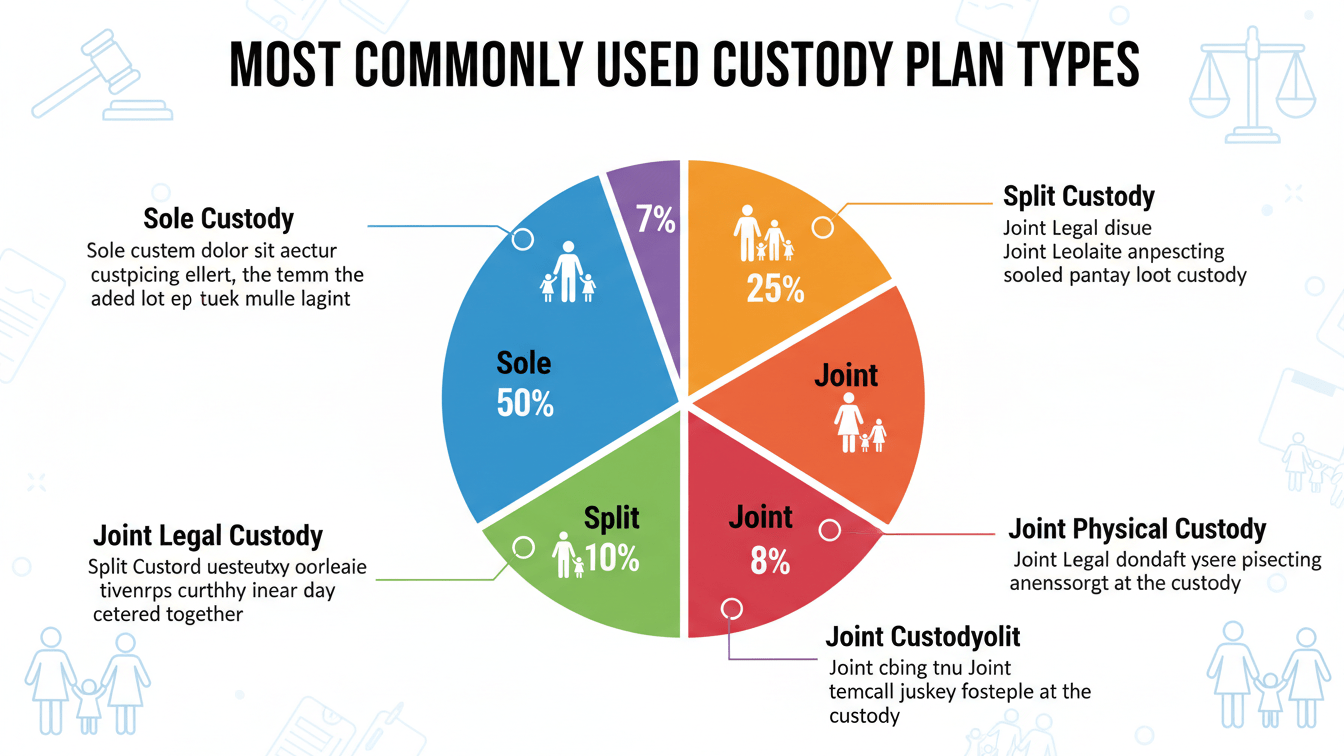
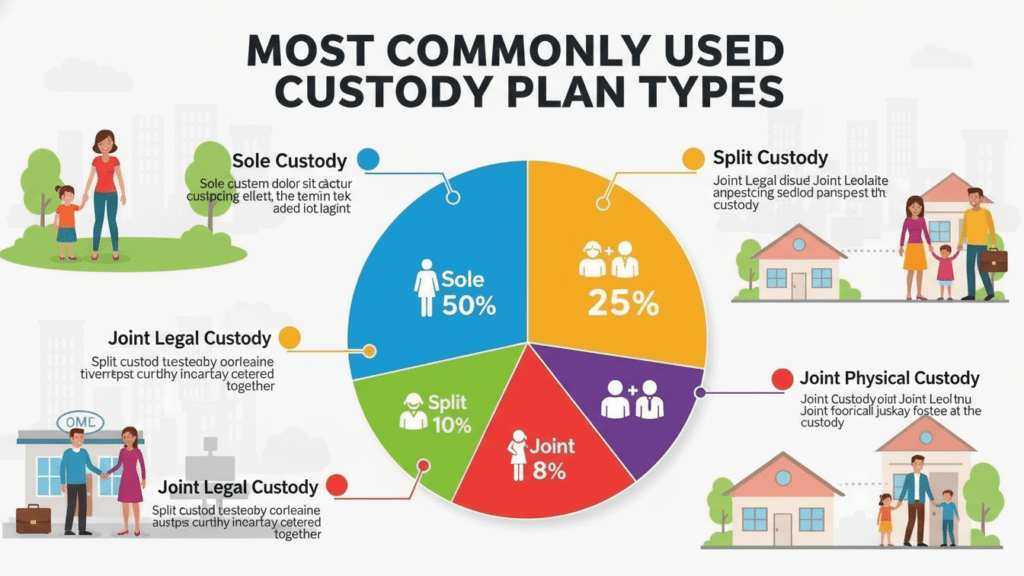
Joint physical custody is the most common custody arrangement, with children splitting time between both parents. This arrangement helps maintain strong parent-child relationships and is often seen as being in the best interest of the child.
Joint custody allows both parents to be involved in their child’s upbringing. It provides balanced time and helps children adjust to the new family dynamic after divorce.
- Involvement from Both Parents: Joint custody ensures that both parents remain active in their child’s life.
- Balanced Time: The child benefits from spending substantial time with both parents.
- Reassurance for Children: Joint custody provides emotional stability.
- Disagreements: Parents may struggle to agree on important decisions.
- Need for Communication: Effective communication is essential for joint custody to work.
- Different Schedules: Conflicting schedules can create logistical challenges.
When deciding on custody arrangements, courts take into account a number of criteria, such as:
- Child’s Age: Younger kids might need extra security.
- Parents’ Ability to Care for the Child: Courts evaluate each parent’s capacity to meet the child’s needs.
- Child’s Attachment to Each Parent: The child’s relationship with each parent is carefully assessed.
- Living Situation: The court examines the living conditions and stability of each parent’s home.
- History of Abuse or Neglect: Any history of abuse will heavily influence custody decisions.
For more information, read the article on Factors Courts Use to Set Child Support.
Legal custody refers to decision-making rights, while physical custody determines where the child lives. Parents can share one or both forms of custody depending on their situation.
Sole custody means that one parent has either full legal or physical custody, while joint custody divides these responsibilities between both parents.
When creating a custody plan, flexibility and compromise are essential. Parents should seek legal assistance if needed and consider mediation options to resolve disputes.
Common Custody Schedules Explained
Custody schedules define how parenting time is divided. Below are the most popular custody schedule formats used within modern custody plan types.
2‑2‑3 Custody Schedule
The child spends two days with Parent A, two days with Parent B, and three days with Parent A, rotating weekly.
Pros:
- Frequent contact with both parents
- Balanced time
Cons:
- Frequent transitions
- Can be difficult for young children
2‑2‑5‑5 Custody Schedule
The child spends two days with each parent and alternates five‑day blocks.
Pros:
- Fewer exchanges
- Predictable schedule
Cons:
- Requires strong planning for school activities
Alternating Week Schedule
The child lives with each parent for one full week at a time.
Pros:
- Stability and routine
- Fewer transitions
Cons:
- Long separation from one parent
3‑4‑4‑3 Custody Schedule
Parents alternate blocks of three and four days to ensure equal weekly time.
Best for:
- Parents living close together
- Older children with structured routines
5‑2‑2‑5 Custody Schedule
The child spends five days with one parent, two with the other, then switches.
Benefit:
- Balanced parenting time
- Predictable weekdays
Bird’s Nest Custody: A Child-Centred Approach
Bird’s nest custody allows the child to remain in one home while parents rotate in and out.
Advantages:
- Minimal disruption for the child
- Stable environment
Challenges:
- High financial cost
- Requires strong cooperation
This is one of the least common custody plan types, but it can be effective in short‑term arrangements.
Why Joint Custody Is the Most Common Choice
Joint custody is widely viewed as beneficial when parents can cooperate.
Benefits for children:
- Emotional reassurance
- Strong parental bonds
- Balanced upbringing
Potential challenges:
- Scheduling conflicts
- Decision‑making disputes
Despite challenges, joint custody remains one of the most favoured custody plan types by family courts.
Factors Courts Consider When Choosing Custody Plan Types
Judges evaluate several factors before approving a custody plan:
- Child’s age and developmental needs
- Each parent’s ability to provide care
- Emotional attachment to each parent
- Stability of each home environment
- History of abuse, neglect, or substance use
The child’s safety and long‑term well‑being always come first.
Physical Custody vs Legal Custody: Key Differences
| Aspect | Physical Custody | Legal Custody |
| Focus | Where the child lives | Decision‑making authority |
| Can Be Shared | Yes | Yes |
| Can Be Sole | Yes | Yes |
Parents may share one type while one parent holds the other.
Creating a Strong and Flexible Custody Plan
Successful custody plans require:
- Willingness to compromise
- Clear schedules
- Conflict‑resolution methods
- Child‑focused decision‑making
Many parents benefit from mediation or legal guidance when finalising custody plan types.
FAQs:
What are custody plan types?
Custody plan types are structured arrangements that define how parents share responsibility for their child after separation or divorce. These plans outline physical custody, legal custody, and parenting time schedules. Family courts use custody plan types to ensure a child’s emotional stability, safety, and long-term well-being while maintaining meaningful relationships with both parents whenever possible.
How do custody plan types work in real life?
In practice, custody plan types guide where the child lives, how often they see each parent, and who makes important decisions about education, healthcare, and upbringing. For example, in joint physical custody, a child may split time between two homes, while sole custody places most responsibilities with one parent. Courts expect parents to follow these plans consistently to reduce conflict and provide routine for the child.
Why are custody plan types important for children?
Custody plan types provide children with structure during a time of major change. Clear custody arrangements reduce uncertainty, limit parental conflict, and support emotional security. Research and family court experience show that children adjust better when custody plans are predictable, child-focused, and designed around the best interests of the child rather than parental disputes.
Who decides which custody plan type is best?
If parents agree, they can propose a custody plan to the court. If they cannot agree, a family court judge decides which custody plan type is appropriate. Judges evaluate factors such as parenting ability, home stability, emotional bonds, and any history of abuse or neglect. In some cases, custody evaluators or child psychologists may provide expert input.
What is the difference between legal custody and physical custody?
Legal custody refers to decision-making authority over major aspects of a child’s life, such as schooling, medical care, and religion. Physical custody determines where the child lives day-to-day. Parents may share one type while one parent holds the other, depending on what best supports the child’s needs.
Why is joint custody one of the most common custody plan types?
Joint custody is widely used because it allows both parents to remain actively involved in their child’s life. Courts often favor this arrangement when parents can communicate respectfully and live reasonably close. Joint custody supports emotional balance, maintains parent-child bonds, and promotes shared responsibility, which is often seen as beneficial for a child’s development.
When should custody plan types be modified?
Custody plan types can be modified when there is a significant change in circumstances, such as relocation, changes in work schedules, a child’s evolving needs, or safety concerns. Courts require proof that the modification serves the child’s best interests, not just parental convenience.
How are parenting time schedules decided?
Parenting time schedules are based on the child’s age, school routine, parental availability, and emotional needs. Common schedules include alternating weeks, 2-2-3 plans, and 5-2-2-5 arrangements. Courts aim to minimize disruption while ensuring both parents have meaningful time with the child.
Wrap UP:
Choosing the right Custody Plan Types is one of the most important decisions parents make after separation or divorce. A well-structured custody plan is not about favoring one parent over the other—it is about protecting the child’s emotional health, stability, and future well-being.
Understanding how different custody plan types work—such as joint custody, sole custody, legal custody, and physical custody—helps parents make informed, responsible choices. Courts consistently focus on the best interests of the child, considering factors like safety, consistency, parental involvement, and the child’s emotional bonds.
The most successful custody plans are those built on cooperation, clear communication, and flexibility. Parenting schedules, decision-making authority, and living arrangements should evolve as a child grows and their needs change. When conflicts arise, mediation or professional legal guidance can help parents resolve issues without unnecessary stress on the child.
In the end, the goal of all custody plan types is the same: to create a secure, loving, and supportive environment where a child can thrive. By prioritizing stability and cooperation, parents can turn a challenging transition into a healthy new chapter for their family.
References:
Kelly, J. B. & Emery, R. E. (2003). Children’s Adjustment Following Divorce: Risk and Resilience Perspectives. Family Psychology Press.
Austin, W. G., & Dolan-Del Vecchio, K. (2019). The Divorce Mediation Handbook: Everything You Need to Know from Beginning to End. American Bar Association.
Johnston, J. R., & Campbell, L. E. G. (1993). Impassioned Friends: Protecting the Parent-Child Relationship in High-Conflict Divorce. Free Press.
Emery, R. E. (2011). Renegotiating Family Relationships: Divorce, Child Custody, and Mediation. Guilford Press.
Birnbaum, R. (2003). Mom’s House, Dad’s House: Making Shared Custody Work. Simon & Schuster.
Warshak, R. A. (2014). Divorce Poison: How to Protect Your Family from Bad-mouthing and Brainwashing. Macmillan.
Saini, M. (2014). The Best Interests of the Child: An Evidence-Based Approach. Oxford University Press.
Gardner, R. A. (1998). The Parental Alienation Syndrome: A Guide for Mental Health and Legal Professionals. Creative Therapeutics.
Fidler, B. J., Bala, N., & Saini, M. A. (2013). Child Custody Assessments: A Handbook for Practice and Research. Oxford University Press.
Emery, R. E., Sbarra, D. A., & Grover, T. (2005). Divorce and Children: What Happens and How to Help Them Thrive. Family Relations Press.